
Wine bottles do not come in just one size. Different wine bottle sizes are typically associated with different serving quantities, occasions, storage methods, and product positioning.
So, how big is a standard wine bottle? How many glasses of wine are in a 375 ml bottle? And how many standard wine bottles does a Magnum contain?
This guide provides a comprehensive overview of common wine bottle sizes, including bottle capacity, common names, the equivalent number of standard 750 ml bottles, the approximate number of wine glasses, and typical applications for different bottle sizes.
Common Wine Bottle Sizes
The table below shows some of the most common wine bottle capacities and their corresponding names:
| Wine Bottle Size | Capacity | Equivalent to 750 ml Bottles | Approx. 150 ml Glasses | Common Name |
| 187.5 ml | 0.1875 L | 0.25 bottle | 1 glass | Piccolo / Split |
| 375 ml | 0.375 L | 0.5 bottle | 2–3 glasses | Half Bottle |
| 500 ml | 0.5 L | Approx. 0.67 bottle | 3 glasses | Half-Liter |
| 750 ml | 0.75 L | 1 bottle | 5 glasses | Standard Bottle |
| 1.5 L | 1.5 L | 2 bottles | 10 glasses | Magnum |
| 3 L | 3 L | 4 bottles | 20 glasses | Jeroboam* |
| 4.5 L | 4.5 L | 6 bottles | 30 glasses | Rehoboam* |
| 6 L | 6 L | 8 bottles | 40 glasses | Methuselah* |
| 9 L | 9 L | 12 bottles | 60 glasses | Salmanazar* |
| 12 L | 12 L | 16 bottles | 80 glasses | Balthazar* |
| 15 L | 15 L | 20 bottles | 100 glasses | Nebuchadnezzar* |
The names and capacities of large-format wine bottles may vary depending on the wine-producing region and traditional bottle standards. When purchasing or using these bottles, always confirm the actual capacity and product specifications.
The estimated number of glasses above is based on a serving size of approximately 150 ml per glass. Actual serving sizes may vary depending on restaurants, household drinking habits, and glassware.
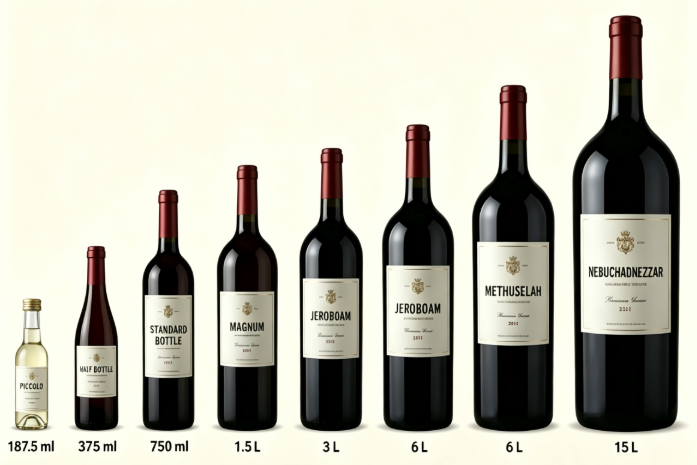
What Is the Standard Wine Bottle Size?
The standard wine bottle size is typically 750 ml.
A 750 ml bottle, or 0.75 liters, is one of the most widely used wine bottle capacities in the global market. For everyday household consumption and table service, a 750 ml wine bottle can generally provide about five glasses when each serving is approximately 150 ml.
Standard 750 ml wine bottles are widely used for:
- Red wine
- White wine
- Rosé wine
- Sparkling wine
- Dessert and sweet wines
- Restaurant and retail wine products
Therefore, when consumers see the term “wine bottle” without a specified capacity, it generally refers to a 750 ml standard wine bottle.
Why Is a Standard Wine Bottle 750 ml?
There are several historical explanations for why 750 ml became a common wine bottle capacity. These include early glassmaking techniques, historical measurement systems, and long-standing trade practices.
Rather than attributing the 750 ml standard to one single historical reason, it is more accurate to say that 750 ml became widely adopted through long-term trade, manufacturing, and market practices.
Today, 750 ml is a familiar bottle capacity for consumers, wineries, restaurants, retailers, and packaging suppliers around the world.
Small Wine Bottle Sizes
In addition to the standard 750 ml bottle, smaller wine bottles are widely used in hotels, airlines, restaurants, gift sets, and single-serving applications.
187.5 ml Wine Bottle
A 187.5 ml wine bottle is a common small-format wine bottle and is often referred to as a Piccolo or Split.
A 187.5 ml bottle provides approximately one standard 150 ml serving, with a small amount left over. This makes it suitable for:
- Individual consumption
- Airline service
- Hotel rooms
- Events and conferences
- Gift sets
- Wine tasting activities
This size can also help reduce waste compared with opening a full 750 ml bottle when only a small quantity of wine is needed.
375 ml Wine Bottle
A 375 ml wine bottle is commonly known as a Half Bottle, because it contains half the capacity of a standard 750 ml wine bottle.
Based on a 150 ml serving size, a 375 ml bottle can provide approximately two to three glasses of wine.
This size is suitable for two-person dining, small gatherings, restaurant pairing, and consumers who prefer a smaller quantity of wine.
Therefore, when consumers search for a half bottle of wine, they are generally referring to a bottle with a capacity of around 375 ml.
500 ml Wine Bottle
A 500 ml wine bottle falls between the 375 ml and 750 ml sizes and can provide approximately three 150 ml servings. Although 500 ml is not one of the most common wine bottle sizes across all wine categories, it can be found in certain dessert wines, specialty wines, and specific markets.
750 ml Wine Bottle: The Most Common Standard Size
The 750 ml wine bottle is one of the most familiar bottle capacities in the wine market.
A 750 ml bottle generally provides about five glasses of wine when each serving is approximately 150 ml.
From a consumer perspective, 750 ml provides a practical balance between bottle capacity and the number of people served. From a production and retail perspective, it is also a convenient size for packaging, transportation, storage, and sales.
Therefore, when discussing wine bottle capacity, 750 ml is usually the most important reference size.
What Is a Magnum Wine Bottle?
A Magnum wine bottle has a capacity of 1.5 liters and is equivalent to two standard 750 ml wine bottles.
The conversion is straightforward:
1 Magnum = 1.5 L = 2 × 750 ml bottles
Based on a serving size of 150 ml, a 1.5 L Magnum can provide approximately 10 glasses of wine.
How Many Bottles Are in a Magnum?
One Magnum is equivalent to:
2 standard wine bottles
In other words, one 1.5 L Magnum contains the same amount of wine as two standard 750 ml bottles.
How Many Glasses Are in a Magnum?
If each glass contains approximately 150 ml:
1.5 L ÷ 150 ml ≈ 10 glasses
The actual number of glasses will depend on the amount poured into each glass.
Why Are Magnum Wine Bottles Popular?
Large-format wine bottles are often used for:
- Weddings
- Banquets
- Celebrations
- Restaurants
- Winery events
- Collecting and special-vintage wines
Compared with standard 750 ml bottles, Magnum bottles are particularly suitable for occasions where wine is shared among multiple people.
Large Wine Bottle Sizes
In addition to the Magnum, wine is also available in much larger bottles. These are generally known as large-format wine bottles.
Common large-format sizes include:
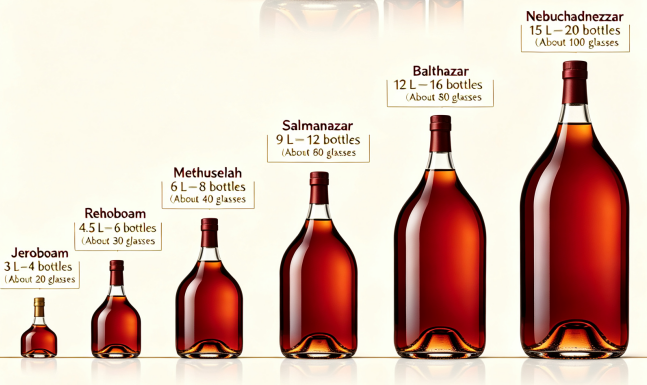
3 L — Jeroboam
A 3 L bottle is equivalent to four standard 750 ml wine bottles. Based on a 150 ml serving size, it can provide approximately 20 glasses of wine.
4.5 L — Rehoboam
A 4.5 L bottle is equivalent to six standard 750 ml wine bottles. Based on a 150 ml serving size, it can provide approximately 30 glasses.
6 L — Methuselah
A 6 L bottle is equivalent to eight standard 750 ml wine bottles. Based on a 150 ml serving size, it can provide approximately 40 glasses.
9 L — Salmanazar
A 9 L bottle is equivalent to twelve standard 750 ml wine bottles. Based on a 150 ml serving size, it can provide approximately 60 glasses.
12 L — Balthazar
A 12 L bottle is equivalent to sixteen standard 750 ml wine bottles. Based on a 150 ml serving size, it can provide approximately 80 glasses.
15 L — Nebuchadnezzar
A 15 L bottle is equivalent to twenty standard 750 ml wine bottles. Considering its serving size of 150 ml, it can provide about 100 glasses.
It is worth noting that names of large wine bottles do not entirely agree throughout the world where the production of wine is done. For instance, some names like Jeroboam may be used to refer to various sizes of wine in different wine-making areas.
Thus, when buying, producing, and selling large wine bottles, it is advisable to consider the exact specifications rather than the names of the bottle.
How Many Glasses Are in a Wine Bottle?
Many consumers search for how many glasses in a wine bottle when they want a simple way to convert bottle capacity into servings.
Using 150 ml as the reference serving size:
| Wine Bottle Capacity | Approx. Number of Glasses |
| 187.5 ml | 1 glass |
| 375 ml | 2–3 glasses |
| 500 ml | 3 glasses |
| 750 ml | 5 glasses |
| 1.5 L | 10 glasses |
| 3 L | 20 glasses |
| 6 L | 40 glasses |
| 15 L | 100 glasses |
These figures are estimates. For example, if each serving is 120 ml, a 750 ml bottle can provide more glasses. If each serving is 175 ml or more, the number of glasses will decrease accordingly.
Therefore, when calculating the number of wine glasses per bottle, you should consider both the wine bottle capacity and the serving size.
Wine Bottle Sizes vs. Wine Bottle Dimensions
Wine bottle size and wine bottle dimensions are not exactly the same thing.
Wine bottle size generally refers to how much wine the bottle can hold, such as:
- 375 ml
- 750 ml
- 1.5 L
- 3 L
By comparison, wine bottle dimensions refer to the physical measurements of the bottle, including:
- Bottle height
- Bottle diameter
- Base diameter
- Neck length
- Glass thickness
- Overall bottle shape
Two 750 ml wine bottles might have varying exterior dimensions.
Bordeaux, Burgundy, and Champagne style bottles are some examples of wine bottles with distinct variations in their shoulder, body, neck, and shapes.
Consequently, in buying or customizing wine bottles, simply stating that you want 750 ml will probably not be sufficient. You might have to provide further information regarding their dimensions.
Common Wine Bottle Shapes
In addition to capacity, bottle shape is an important part of wine packaging.
Bordeaux Style Wine Bottle
Bordeaux-style wine bottles typically feature defined shoulders and a relatively straight body. They are commonly used for red wines and some white wine products.
Burgundy Style Wine Bottle
Burgundy-style wine bottles generally have more rounded, sloping shoulders and a relatively wider, gently shaped body.
Champagne Style Wine Bottle
Champagne-style wine bottles are primarily used for sparkling wines. Because sparkling wine contains internal pressure, these bottles are generally designed with appropriate glass structures and specifications for the intended product.
Custom Wine Bottle
For wine brands looking to establish a distinctive visual identity, custom wine bottles can provide an opportunity to create unique packaging.
Custom wine bottles can be developed around factors such as:
- Bottle capacity
- Bottle shape
- Glass color
- Bottle dimensions
- Neck and finish specifications
- Brand identity
- Label area
- Packaging requirements
Custom bottles can help wine brands create stronger visual recognition on retail shelves and provide a more distinctive consumer experience.
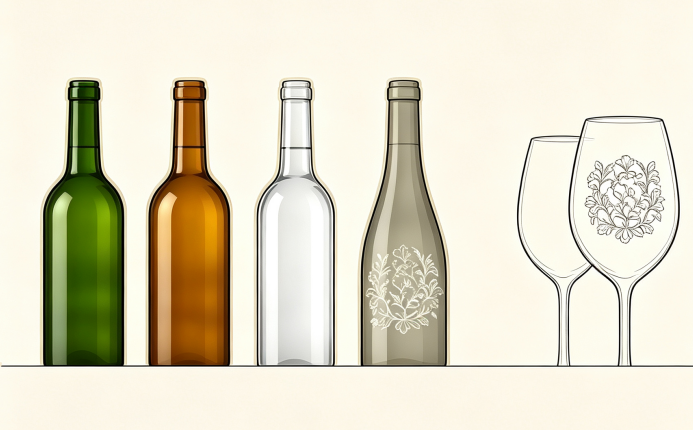
For wine brands looking for standard glass bottles or developing customized packaging, Hengjing Glass can serve as a glass wine bottle supplier for project discussions. The appropriate bottle solution can be evaluated based on specific capacity, bottle shape, dimensions, and customization requirements.
How to Purchase Glass Wine Bottles
In case of wine brands, wineries, importers, and distributors, purchasing wine bottles made of glass should go beyond comparing unit costs.
An efficient wine bottle supplier should be able to easily explain the bottle capacity, bottle size, bottle shape, bottle material specifications, bottle finish, packaging techniques, and manufacturing conditions.
It is essential to verify several things before making the purchase in bulk.
Capacity: Ensure that the bottle capacity is right for filling and suits the market demand.
Dimensions: Check that the bottle fits your filling, labeling, carton, storage, and handling systems.
Shape of Bottle: Ensure that the shape of the bottle reflects the brand positioning and product characteristic of the wine.
Specifications of Glass: Ensure that the specifications of the glass used are right for your application.
Packaging: Ensure that the method of packaging is right for storage and international shipment.
Customized Production: In case of customized production of the bottle, ensure that you have checked all requirements of molds and others before hand.
The choice may further depend on the bottle design, quantity ordered and other factors.
Conclusion
750 ml is the most common standard wine bottle size, but wine bottles are also available in a wide range of capacities, including 187.5 ml, 375 ml, 500 ml, 1.5 L Magnum, and larger formats.
For consumers, understanding wine bottle sizes can make it easier to choose the right bottle for different group sizes and occasions.
For wineries, wine brands, restaurants, importers, and distributors, however, bottle capacity is only one part of the purchasing decision.
When choosing glass wine bottles, not only the wine bottle size but also its dimensions, bottle shape, glass properties, neck finish, labeling, packaging, transportation, and brand identity have to be taken into account.
If you need 750 ml glass wine bottles, small wine bottles, large glass wine bottles, or even develop custom wine bottles, Hengjing Glass will help you evaluate your needs and design a bottle that suits your requirements in terms of capacity, dimensions, and bottle shape.