In the world of whisky, a bottle is far more than a simple container, it serves as a silent ambassador for your brand. Whether you are launching a new brand, introducing a limited-edition super-premium series, or upgrading existing packaging, a unique cIn the premium spirits market, a Custom Brandy Bottle is far more than just a vessel for liquid, it serves as a primary carrier of brand value, shelf presence, and consumer trust. Whether you are launching a new craft brandy, upgrading an existing Cognac product line, or creating a limited-edition Armagnac, selecting the right custom glass design and partnering with a professional manufacturer directly determines your product’s market performance.
As a specialized manufacturer of high-end glass bottles, we understand the precise engineering, aesthetic standards, and supply chain protocols required to turn design concepts into products that meet industrial bottling standards. This guide provides a comprehensive analysis of custom brandy glass bottles, covering material selection, structural design, manufacturing processes, and sourcing strategies.
Why Choose a Custom Brandy Bottle for Your Brand?
Why do more and more spirit brands use custom brandy bottles? This choice is not based only on its looks, but also on the great combination between packaging, positioning, product differentiation, and the requirements of the market.
1. Establishing a Unique Brand Identity
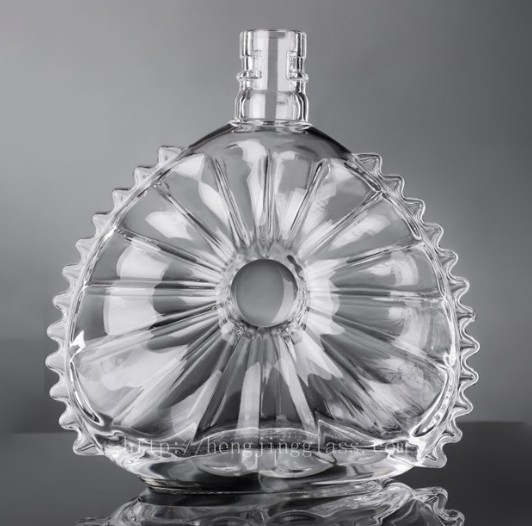
For the premium segment of brandy, the form, proportions, weight, and finish of the custom bottle are the elements that create the first impression for the consumer. Unlike the standard stock bottles, the custom glass bottle enables a unique design of the shoulders, neck, base, and body of the bottle according to its positioning, using embossed logo or special decorations.
2. Meeting Packaging Needs Across Diverse Product Ranges
Brandy bottles that differ in price range and other aspects need to be designed according to specific features of each category of goods. For example, gift line can have fancier silhouette while mass market line pays more attention to functionality, efficiency, and economy. Custom bottles provide companies with an opportunity to modify their packaging strategy in accordance with the selected product lines and their marketing channels.
3. Supporting Brand Differentiation and Product Development
Companies venturing into new markets or looking to create private-label products can use custom bottles to achieve maximum flexibility when it comes to design. Customization in terms of capacity, shape, logo, and closure combination can be achieved in order to match a company’s overall brand strategy.
Note: Unique packaging does not have to involve creating an entirely new mold each time. There can also be instances where using existing private molds along with custom post-processing can prove quite effective.
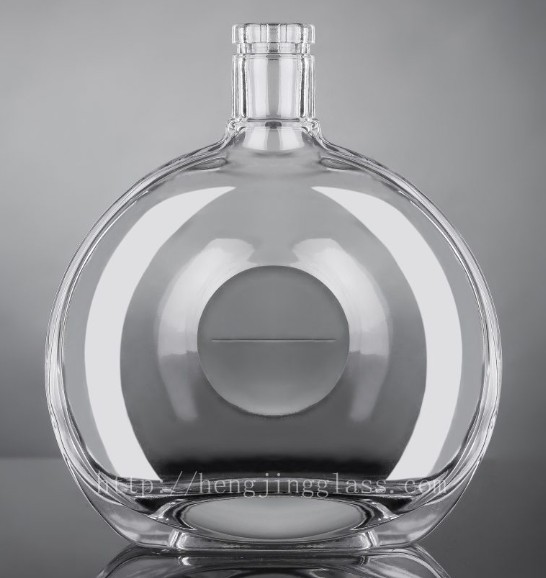
Key Elements of Custom Brandy Bottle Design
Custom packaging of Brandy and Cognac requires the production of unique custom bottles, which are a combination of mechanics, materials, and industrial automation.
In order to make sure that the custom bottles for Brandy meet the standards of being luxurious and commercially viable at the end market, there are some four main aspects that need to be emphasized:
1. Glass Material & Optics
Brandy is aged for a considerable time period in oak barrels, producing a wide range of colored liquids, from amber to reddish-brown and even deep golden colors.
Super Flint Glass (Extra Flint / Crystal Flint):
Core Characteristics: Made of ultrapure raw materials (maximum iron content does not exceed 0.02%), has outstanding optical purity, minimal color dispersion, and a refractive index close to that of crystal.
Application: Perfect material for luxury liquors, XO Cognac and limited edition drinks. In ambient light conditions, it provides a stunning effect of aged spirits, tear legs (viscosity), and golden color.
High Flint Glass:
Core Characteristics: Offers good light transmission along with outstanding mechanical resistance and excellent process stability.
Application: Is considered the benchmark for mid to high-end VSOP and commercial brandy products, providing the perfect blend of cost and texture.
2. Dimensions, Weight & Mechanics
The structural design of a brandy bottle must balance ergonomic hand-feel, shelf display proportions, and legal compliance across different global regions.
| Parameter Dimension | Standard & Specification Parameters | Engineering & Customization Considerations |
| Standard Capacity | 500ml / 700ml (Eurasian Standard) / 750ml (North American Standard) / 1000ml / 50ml (Miniature) | Brimful Capacity Control: Precise volume tolerances must be calculated to allow for liquid thermal expansion/contraction and headspace, preventing leakage during transit. |
| Base Design | Flat Base, Punt, Heavy Base (Punt / Heavy Bottom) | Heavy Base Process: A thick base (typically 15–30mm+) significantly lowers the center of gravity and increases display stability. Anti-counterfeiting markings, anti-slip stippling, or embossed logos can be integrated into the bottom. |
| Weight Range | 500g – 1200g+ (Depending on wall thickness and base weight) | Wall Thickness Uniformity: Heavyweight bottle designs require precise annealing control to eliminate internal stress caused by uneven cooling. Logistics costs and carbon footprint should also be evaluated for heavy bottles. |
3. Closure Systems & Neck Finish
Brandy is an alcohol with a high proof level, and therefore, the sealing system has to guarantee no leakage and no oxidation capability in long-distance transport as well as long-term storage.
T-Top / Bar Top Corks:
Craft Details: The classic brandy closure. Cork bodies can be made from high-density natural cork, micro-agglomerated cork, or food-grade synthetic materials. Caps can be customized in solid wood, die-cast zinc alloy, electroplated metal, or glass.
Neck Compatibility: The inner diameter tolerance of the neck finish must be strictly controlled within ±0.3mm\pm0.3\text{mm}±0.3mm to ensure appropriate extraction force and a tight seal.
ROPP / GPI Screw Finish:
Craft Details: Aluminum roll-on tamper-evident caps or threaded finishes.
Application: Ideal for high-speed automated bottling lines, offering high sealing reliability and cost-efficiency, commonly used for base spirits or fast-moving consumer lines.
Decanter Glass Stoppers:
Craft Details: Paired with frosted glass ground joints or non-toxic silicone rings for sealing.
Application: Designed for luxury gift boxes, high-vintage XO, or decanter-style bottles, offering collectible value and secondary display potential.
4. Surface Processing & Decoration
Post-processing decoration techniques are essential for embedding brand identity and tactile experiences into the glass itself.
Mold Embossing & Debossing: Mold the 3D coat of arms, logo, or texture onto the neck, body, or bottom of the glass. This needs a precision mold and correct draft angles so that it does not scratch during mold removal.
High-Temperature Screen Printing & Precious Metal Hot Stamping: High Temperature Screen Printing and Precious Metal Hot Stamping: By using high temperature glass enamels/pastes with real gold or silver, which are then fired to 500°C – 600°C, thus forming a bond with the glass surface.
Frosting, Acid Etching & Spray Coating:
Frosting / Acid Etching: Gives the bottle body a soft matte texture and smooth tactile feel.
Spray Coating: Supports full-body color, gradient spraying (e.g., transparent base transitioning to a dark top), or matte finishes, providing light protection while delivering modern visual impact.
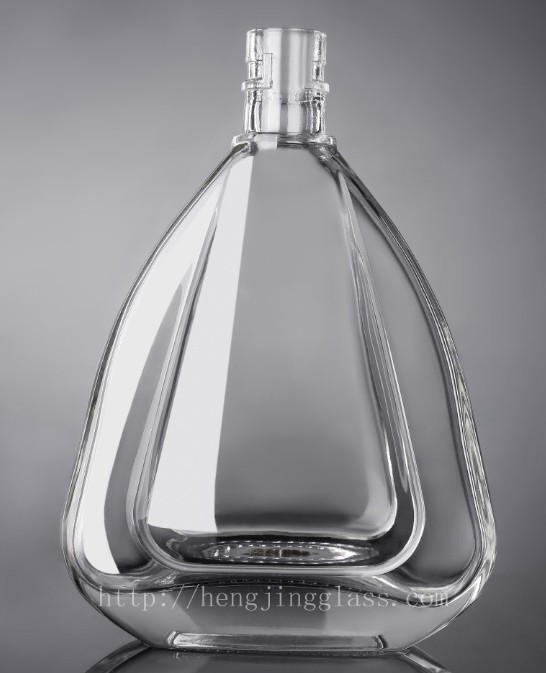
Custom Brandy Bottle vs. Stock Brandy Bottle: Which Is Better?
When launching a brandy packaging project, distillery managers and sourcing directors often face a key decision: Should you purchase stock glass bottles or invest in new custom molds?
To help you make the best choice based on your budget and business development, here is a detailed comparison across key dimensions:
| Comparison Dimension | Stock Brandy Bottle | Custom Brandy Bottle |
| Design Uniqueness | Generic shapes; risk of looking similar to other spirits brands on the market. | 100% exclusive bottle shape; brand logos and crests can be directly molded into the glass. |
| Upfront Development Cost | Zero Mold Cost. | Requires upfront mold investment (Sample & Production Molds). |
| Lead Time | Fast delivery; usually ships within days to two weeks after order placement. | Requires mold sampling and mass production; lead time typically ranges from 45 to 60 days. |
| Brand Premium Ability | Ideal for entry-level product lines or rapid market testing. | Very high; optimal for premium XO, VSOP, aged brandies, and flagship products. |
Sourcing Recommendations:
Choose Stock Bottles: If you are a new brand with a restricted budget, a rush entry into the market, or you are producing a small pilot batch, then the choice of stock bottles along with labeling or screen printing is an ideal combination.
Choose Custom Bottles: If your aim is to create an upscale brand that has asset value, differentiate on the shelf, or have tough anti-counterfeiting mechanisms, then custom mold creation is the ultimate solution.
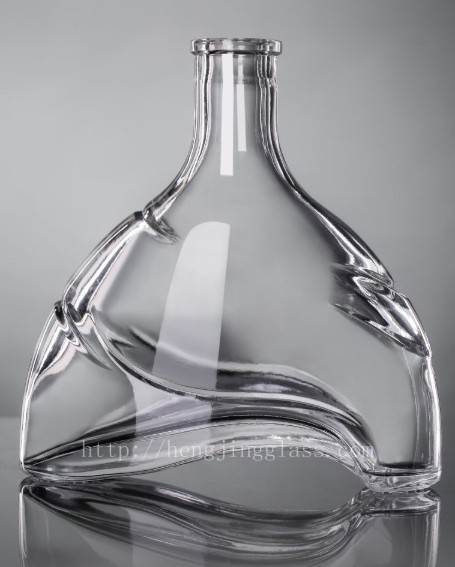
Step-by-Step Manufacturing Process of Custom Brandy Bottles
Transforming the design into good quality glass bottles through a physical industrial manufacturing process requires thoroughness and standardization when working with an experienced professional manufacturer:
3D Drawing & Engineering Modeling
The engineering team turns the conceptual sketches into 3D CAD drawings. The areas of focus involve the correct calculations of nominal capacity, brimful capacity, thermal expansion space, and draft angles and neck tolerances to allow compatibility with automated bottling lines.
Sampling Molds & Physical Testing
Prior to mass production, one cavity sample molds are constructed in order to manufacture physical samples made of glass. The physical glass samples are then tested for super flint clarity, base weight, proportions, capacity tolerance calibration, stopper pull tests, and leakage testing. After passing the tests, samples are approved for production.
Mass Production & Annealing Temperature Control
Multi-cavity molds are set up in automated Individual Section (IS) machines for large scale glass forming. Once the glass bottles are formed, they are immediately placed in multi-meter annealing lehr for gradual cooling in order to reduce internal stresses and avoid any bursting due to thermal shock.
Quality Inspection & Post-Processing
Automatic AI optical inspection systems carry out 100% inspections of neck flatness, wall thickness, seeds/bubbles, and inclusion. The process is further enhanced through thermal shock and pressure sampling. The qualified bare bottles then go through hot stamping, screen printing, spraying, and frosting.
Export-Standard Packaging & Delivery
The finished bottles are packed using robust cartons fitted with honeycomb partitions or using the “thick honeycomb paperboard+fumigated wooden pallet+shrink wrap” combination method. This helps in eliminating any risk of bottles hitting one another causing scratches. This ensures zero breakage during ocean transport.
How to Select a Custom Brandy Bottle Manufacturer
Selecting the appropriate glass bottle supplier can affect the texture of the product, its consistency, and timeliness of delivery. We would like to suggest that you assess each supplier in terms of the following four factors:
Evaluate Factory Capabilities and Capacity:
Check if the factory’s technology and materials fit your requirements for the project. If your product is premium quality brandy, pay attention to their capacity in Super Flint melting and heavy base casting.
Audit Physical Samples and Quality Standards:
Request physical samples and clarify acceptance criteria prior to mass production. Inspect glass clarity, wall thickness uniformity, and surface defects, and test the seal fit between the neck finish and T-top corks or glass stoppers. If you operate automated filling lines, perform line-compatibility tests in advance.
Define Customization Depth and Secondary Processing:
Find out whether the product demands full custom mold design (for example, 3D body embossing and custom bases), or stock molds with secondary decoration processes (for example, hot stamping at high temperatures, screen printing, color spraying or frosting). Clear project boundaries help avoid unnecessary mold costs and shorten development cycles.
Compare Total Landed Cost and Logistics Packaging:
Examine the quotations based on “Total Landed Cost,” keeping in view not only the cost of the bare bottle but also including the costs of the molds, decorations, accessory matches, packaging, and ocean shipping. Make sure that the trade terms (such as FOB or CIF) and the export packing requirements (such as partitions in boxes or fumigated pallets) are correct.
Partner with Hengjing Glass for Your Custom Brandy Bottle Project
As part of your packaging plan for your spirits, the custom glass package solution must be able to satisfy aesthetic needs, manufacturability, and cost of procurement.
With our expertise in custom glass bottle manufacturing, Hengjing Glass is committed to offering you one-stop solutions in customizing your spirits packaging from the world’s top spirit brands, local craft distilleries, and international packaging importers. Equipped with modern manufacturing equipment, ultra clear crystal flint furnaces, and post-production processing lines, we are ready to fulfill your packaging needs!
Is your bradn brandy’s packaging ready to take off? Connect with the Hengjing Glass team today to get free consultations, quotations, or sample packs!