
When you pour champagne into a glass you will witness little streams of bubbles appearing all the time from various locations on the surface of the glass. These streams are venting dissolved carbon dioxide out of the wine. Tiny particles and surface defects provide nucleation sites for bubbles. To understand the behaviour of champagne glasses with bubbles we need to look at the science of nucleation and the design of the glass. For more on how the bubbles are formed, have a look at the Champagne Committee’s description of the process.

How Do Bubbles Form and Rise in Champagne Glasses?
The development and rising of bubbles in a glass of champagne is a process that requires gas solubility and small physical surfaces.
Carbon dioxide release and nucleation: When you open the bottle and pour into the glass, supersaturated carbon dioxide starts to find a route out. Bubbles generally originate at “nucleation sites” which are microscopic particles adhered to the glass wall, fibres or very small structural flaws on the glass surface.
Bubble growth and detachment Carbon dioxide molecules that are dissolved in the wine diffuse to these small cracks. As the bubble increases, so the buoyancy on it increases. If buoyancy and other factors are adequate to pull the bubble away from the nucleation site, it easily escapes the wall of the glass and rises to the surface of the liquid. The study of flow patterns of champagne bubbles contributes to the understanding of bubble migration and fluid dynamics in the liquid.
Continuous bubble chains formation When a bubble leaves a nucleation site and rises it does not always fill the whole interior of the nucleation site with liquid and a little pocket of gas may be left behind. This residual gas can assist the subsequent gas to gather at nucleation sites which can continually form bubbles. This means the same place might emit a bubble after bubble, creating a visible chain of bubbles and causing little flows of liquid.
How Does the Glass Surface Affect Bubble Formation?
The microscopic state of the glass surface and its treatment have direct consequences on the circumstances for bubble nucleation and presentation.
Microscopic Imperfections and Cleaning Conditions
When you look at a glass surface , it looks smooth and flat . But there may be microscopic textures . potentially, airborne particles or small fibres left by cleaning cloths may potentially provide natural nucleation sites.
Remember that grease, detergent residue and other impurities on the glass wall may alter the surface wettability and circumstances for bubble formation. The way champagne glasses are cleaned and rinsed can affect how the bubbles perform, and the exact impact relies on the type of residue and the state of the glass surface.
Nucleation Sites Designed on the Glass Base
Some champagne glasses have special treatments of the surface of the base to generate spots that facilitate bubble nucleation. The nucleation sites are affected by such treatments, enabling the continual bubbling from a defined location on the base.
However the actual performance is also affected by the method of surface treatment, the state of the glass surface, the dissolved carbon dioxide in the wine and the conditions of use. This means that bubble streams can vary greatly from glass to glass and the final result cannot be determined merely on the basis of whether the base has been treated.
How Does Champagne Glass Shape Change the Appearance of Bubbles?
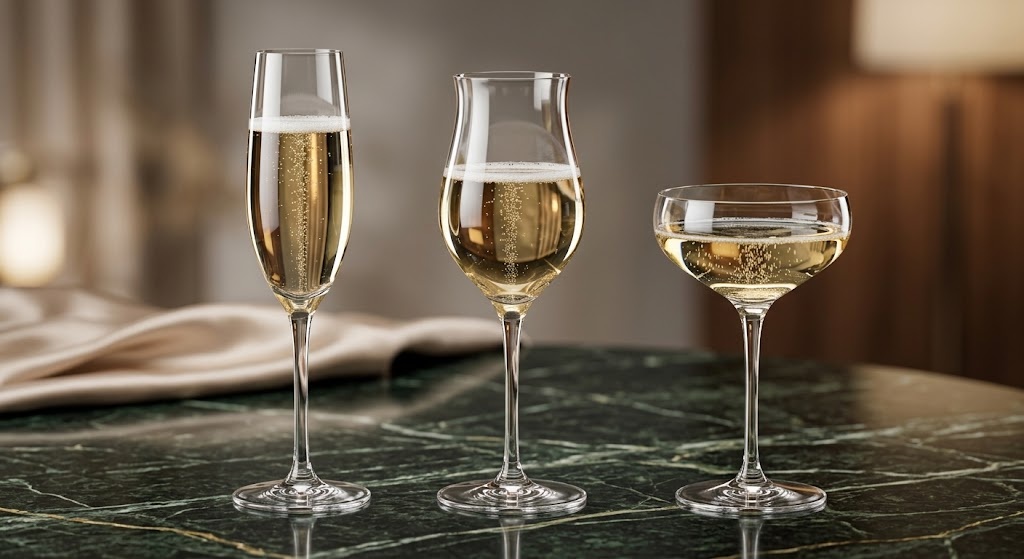
The form of the glass influences the bubbles’ visibility, the surface area of the wine in contact with air and the concentration of aroma. Not all glass shapes are identical in their behaviour:
Champagne Flute: Although the thin, tapered body makes it easy to watch the rising bubbles, the real rate of gas loss is still influenced by wine temperature, rim structure and other conditions.
Tulip Glass: The body is wider and the rim is narrow, giving the possibility of bubble creation, but also aiding to gather aroma.
Coupe Glass: A broad shallow bowl gives the wine greater surface area to breathe and generally allows bubbles and perfume to escape more readily.
The differences between the types of champagne glasses are due to the interaction of the bubble display, the release of the aroma and the shape of the bowl.
What Should Buyers Consider When Choosing Champagne Glasses?
If you are a hotel, caterer, large event planner or wholesaler, you will need to consider visual presentation, durability and bulk supply needs when selecting champagne glasses.
Clarity: the surface of the glass must be as clear as possible to be able to see the colour of the wine and bubbles clearly.
Durability: The rim, stem and base structure should be acceptable for the frequency of usage, methods of cleaning and circumstances of handling. Purchase sampling inspection and associated testing can be used to determine product performance at time of purchase.
Consistency: Glass shape, capacity, dimensions, weight, surface treatment and acceptance requirements should be specified for bulk orders to reduce variations between batches.
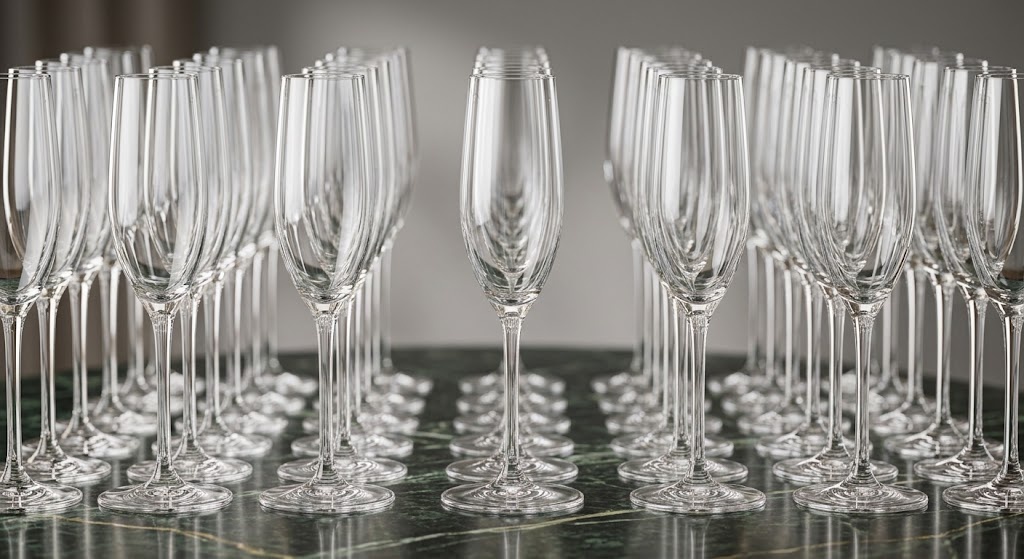
For enterprises that need to buy in bulk, when choosing champagne glasses in bulk, they should assess the suppliers according to the samples, product specifications, and quality inspection demands, rather than only compare the unit prices.
If the present styles can’t meet the look or size needs of a corporation, you can also learn about Hengjing Glass’s glassware customisation services to confirm configurable shapes, capacities, surface decoration and branding options.
Summary
The rising bubbles in a glass of champagne are the result of the combined action of supersaturated carbon dioxide, the physical mechanism of nucleation and the geometry of the glass. The microscopic state of the glass wall, the design of nucleation points at the bottom and the structure of different glass forms together control the visual presentation of bubbles and scent release. The knowledge of these objective laws can allow the buyers of the food and beverage industry and clients of the brand to select and customise high-quality champagne glass goods according to specific commercial usage scenarios.