
Purchasing shot glasses in bulk is definitely a good decision for bars, restaurants, hotels, event organizers, and marketing companies, as it allows saving money and guarantees a constant stock of shot glasses. But since all glass products are quite delicate items, any defect in large quantity may turn into a problem that will destroy all the benefits of bulk purchasing.
In order to receive desired result, there are four important aspects to consider: uniformity of specifications, acceptance of samples, control of breakage rate, and transport packaging. Consideration of these points before placing an order will help you to minimize risks.

Spec Uniformity – Make Every Glass Identical
As people set out their shot glasses at the bar or place them in storage, any differences that occur in terms of height, diameter, or volume will be very noticeable. Such irregularities will also cause difficulties with washing and stacking.
Before production begins, lock down these details in writing:
- Capacity – Specify exact volume (e.g., 1 oz, 1.5 oz, or 44 ml) and require a pour-line accuracy of ±2 ml.
- Dimensions – Height, top diameter, base diameter, and wall thickness. Agree on tight tolerances such as ±0.5 mm.
- Shape and style – Classic cylindrical, fluted, square, or novelty shapes. Provide drawings or physical references.
- Material and finish – Soda-lime glass, tempered glass, or crystal. Define clarity, weight, and rim finish.
- Decoration – Logo size, placement, color (Pantone references), and method (screen print, etching, or decal). State durability requirements for commercial dishwashers.
Have the supplier provide you with technical drawings or CAD designs and make them guarantee that the same mold is going to be used throughout the process. Stay away from descriptions such as “approximately 1.5 oz” or “same as the sample picture.” Clear, measurable specifications are the foundation of a successful bulk order of shot glasses.
Sample Acceptance – Never Skip Physical Approval
Photos and verbal promises are not enough. Always require physical samples made from the actual production mold.
A solid sample process usually includes three stages:
- Pre-production sample (PPS) – The first piece from the final mold.
- In-process samples – Random pieces pulled during the production run.
- Pre-shipment sample – A final set taken just before packing.
Inspect each sample carefully for:
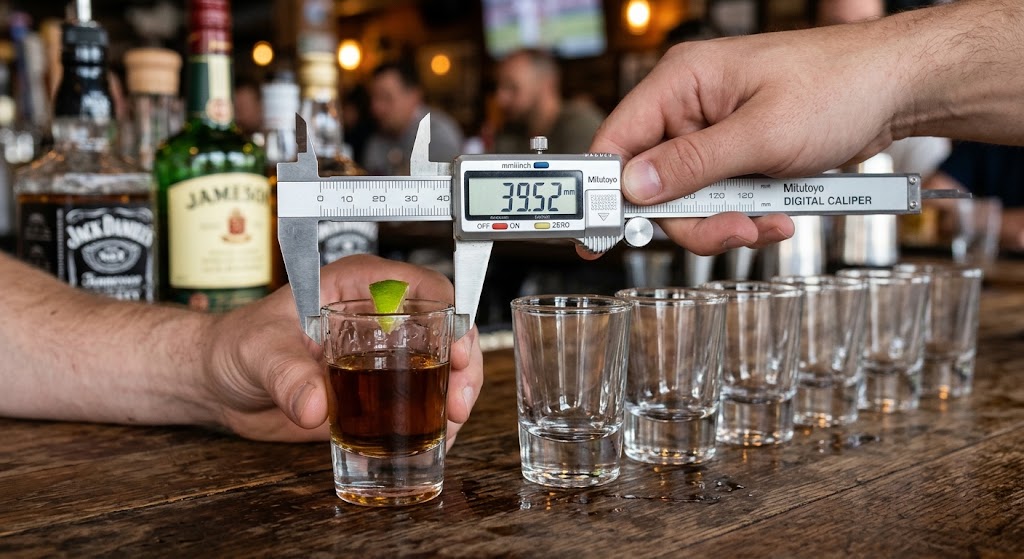
- Exact match to the agreed dimensions and capacity (fill with water and measure).
- Visual quality – no bubbles, seeds, stones, mold marks, or chips.
- Logo clarity, registration, and adhesion. Perform a simple scratch and wash test.
- Weight consistency and balance so glasses sit flat and feel substantial.
Photographs and measurements should be made to document the entire process. Written approval must only be given when the sample fulfills all the requirements. The approved sample will serve as the reference when factory-made parts do not conform to what is expected.
Breakage-Rate Control – Set Clear Expectations
Even well-made glass will break during production, packing, and shipping. The industry norm for properly packed shot glasses is usually 1–3 %. Anything higher should trigger negotiation.
Protect yourself contractually by defining:
- Maximum acceptable breakage percentage.
- Who bears the cost of replacements (supplier, shared, or buyer).
- Whether the supplier will issue a credit or ship free replacements.
From the manufacturer’s perspective, inquire about the annealing process quality, in-line inspection process and their handling of defective products. Ask for any past information about breaking in relation to similar past orders. In large volumes, consider engaging a third party inspector (SGS, Intertek or similar) for statistical sampling prior to shipping.
Defining “A-grade only” and listing critical, major, and minor defects in the purchase order prevents arguments later.
Transportation Packaging – Protect the Investment
Glass takes a long journey from factory to container to storage. Poor packing transforms a small defect ratio into a big problem.
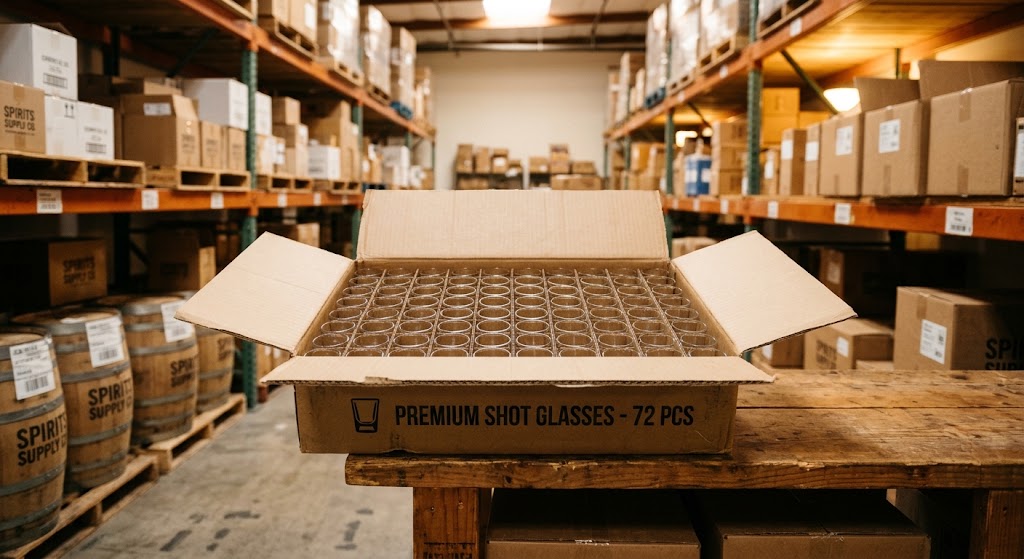
Effective packaging for shot glasses in bulk typically uses multiple layers:
- Individual protection – tissue paper, foam sleeves, or molded pulp trays.
- Inner cartons – sturdy corrugated board with cardboard dividers or egg-crate inserts that keep glasses from touching.
- Master cartons – double-wall corrugated boxes with moisture barriers when needed.
- Palletization – stretch wrap, corner boards, and controlled stacking height.
Provide proof that the packaging has been tested for drops, vibrations, and compressions (ISTA Standards can serve as the basis for comparison). All packages need to be clearly marked as “Fragile – Glass – This Side Up,” and the packing list must match the commercial invoice.
Heavy packaging adds to the freight cost, but the lower claims always compensate for the added cost. Package decisions should be made early so that the supplier may quote the true landed cost.
Putting It All Together
When you request quotations for shot glasses in bulk, specifically ask suppliers to address:
- Detailed dimensional and capacity specifications with tolerances
- Sample approval process and timeline
- Guaranteed maximum breakage rate and replacement policy
- Packaging method, materials, and test results
Make your decision based on these factors rather than the unit cost only. The extra cost incurred when dealing with a supplier that has control over these factors will result in much more cost savings and less stress.
It is important to have all details sorted before you place an order for your shot glasses in bulk. This will make sure that you receive consistent, high-quality glassware.