When purchasing glass packaging, custom glass bottles are one of the most common requirements. Whether it’s cosmetic bottles, essential oil bottles, food bottles or fragrance bottles, many purchases will encounter the same question during the first inquiry: What kind of materials need to be prepared to enable the supplier to provide a solution and quote quickly and accurately?
Incomplete materials often lead to repeated communication, delayed sample production, and even finding that the dimensions are not suitable after mold production. Conversely, the more complete the materials are prepared, the more accurate the quote will be, the shorter the sample production cycle will be, and the smoother the subsequent cooperation will be.Now, let’s thoroughly sort out the materials that need to be provided for custom glass bottles, based on their importance and actual usage scenarios.
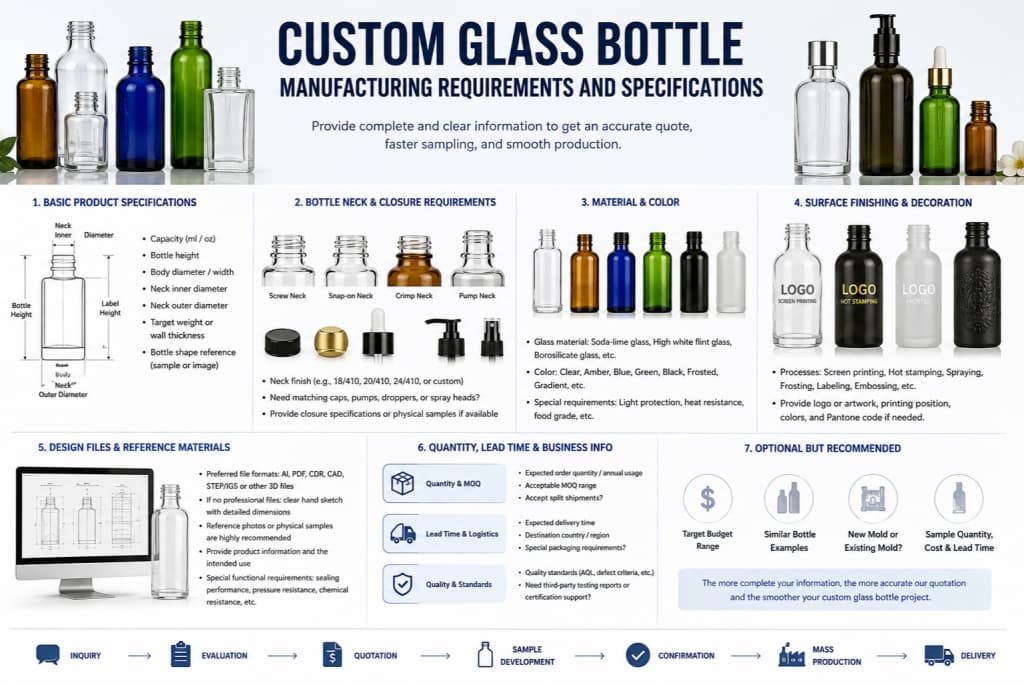
What Information Is Required for Custom Glass Bottles?
This is the basic information that suppliers need to assess feasibility, calculate costs, and arrange sampling. It is recommended to provide all of this information at once.
Basic Product Specifications
Firstly, it is necessary to clearly define the basic dimensions and capacity of the glass bottle, including:
- Bottle capacity: such as 50ml, 100ml, 250ml or other specifications
- Height, diameter or width of the bottle body
- Inner and outer diameters of the bottle mouth
- Target weight or wall thickness requirements
- Ideal bottle shape and appearance
If there are reference samples available, the physical object or clear photos can be directly provided. If you want the product to be similar to a certain glass bottle on the market, reference pictures can also be provided to facilitate the supplier in judging the structure and production plan.
Bottle Neck and Closure Requirements
The bottle mouth is the most prone to problems in the customization process. It is necessary to clarify the following points:
- Bottle mouth type: screw type, snap type, compression type, pump head-specific type, etc.
- Bottle mouth specification: such as common standard specifications like 18/410, 20/410, 24/410, or completely custom sizes.
- Whether a matching cap, pump head, dropper or spray head is required. If so, it is recommended to provide the relevant parameters or physical samples of the cap to avoid mismatches later.
Glass Material and Color
- Glass material: Common types include sodium calcium glass, high whiteness material, borosilicate glass, etc. Different materials vary significantly in terms of transparency, temperature resistance, and cost.
- Colors: Transparent, brownish, blue, green, black, frosted, gradient color, etc.
- Special properties: Whether it needs to be protected from light, withstand high temperatures, be food-grade compatible, have high chemical stability, etc., all of these will affect the material selection.
Surface Finishing and Decoration
If the glass bottles require brand decoration, the process requirements should be determined in advance, including screen printing, gold stamping, silver stamping, spraying, sandblasting, labeling and embossing, etc.
Also provide LOGO, pattern, text content, printing location, number of colors and whether spot colors are required. The more clear the information is, the easier it is for the supplier to accurately assess the process and cost.
Design Files and Reference Materials
1. Provide complete design drafts
Professional design files can significantly enhance communication efficiency. Common formats include AI, PDF, CDR, CAD, as well as STEP, IGS, etc. for 3D structure design.
If there is no professional design draft at the moment, it will not affect the initial communication. The purchaser can provide clear hand-drawn sketches and mark key parameters such as capacity, height, diameter, and bottle mouth size.
If there are physical reference samples, it is recommended to provide photos or directly send the samples, as the physical objects are usually easier for suppliers to judge the structure compared to simple pictures.
2. Explain the Final Application
It is also necessary to inform the supplier what products the glass bottles will be used to fill in the end, such as cosmetics, essential oils, perfumes, honey, alcoholic beverages, or other liquid products.
Different contents may have different requirements for the sealing property, chemical resistance, temperature resistance and strength of the glass. Clearly stating the application scenario in advance can help the supplier recommend more suitable materials and structures.
Quantity, Lead Time, and Business Information
These pieces of information directly affect the quotation structure and production schedule.
Order Quantity and MOQ
- Estimated quantity for the first order or annual usage
- Whether to accept partial deliveries
- The range of acceptance for the minimum order quantity (MOQ)
Quantity is a key factor influencing the unit price and whether new molds need to be made. The more explicit, the better.
Delivery and Packaging Requirements
Specify the expected delivery time and inform the receiving country or region. Different destinations may involve different packaging and transportation methods.
If there are special requirements for packaging, such as anti-damage packaging, neutral packaging, or packaging specified by the customer, these should also be stated before the quotation.
Quality and Inspection Standards
If the company has internal quality standards, they should be provided in advance, such as AQL requirements, appearance defect standards, size tolerances, etc.
For specific markets or application scenarios, if third-party testing reports, food contact-related tests or other certification support is needed, it should also be confirmed in advance so that the supplier can assess whether they can meet the requirements.
Optional Information That Can Help
In addition to the core parameters, it is also necessary to prepare the budget range, previous cases of using similar glass bottles, as well as whether to adopt the new mold or the existing one.
If prototyping is required, it is also recommended to clearly state the estimated number of samples, sample costs, and expected cycle in advance. This way, the supplier can more accurately arrange the entire project process.
Common Issues in Preparing Custom Glass Bottle Materials
Only pictures are provided, no dimensions.
The pictures can help determine the appearance, but they cannot accurately determine the production dimensions. It is best to provide key dimensions or refer to the actual object as well.
The specification of the bottle mouth is unclear.
After the bottle body design was completed, it was discovered that the lid did not match, which would increase the modification cost. Therefore, the specification of the bottle mouth should be confirmed as early as possible.
The size of the design files is incomplete.
If the design draft only has the appearance picture and no height, diameter, bottle mouth and other structural parameters, the supplier still needs to further confirm.
Only provide a part of the information at a time.
Frequent supplementation of materials will increase the number of communication and may also prolong the quotation and sample production time.
If certain parameters are temporarily undetermined, you can directly mark “to be confirmed”, and the glass bottle supplier can assist in evaluation based on the product purpose and production experience, rather than randomly filling in a parameter.
Conclusion
Customizing glass bottles is not as simple as providing just one picture and then starting the production. Capacity, size, bottle mouth, material, color, surface treatment, design documents, usage scenarios, quantity and quality requirements all affect the final product plan and cost.
Preparing a complete demand document before the formal inquiry can reduce repeated communication, improve the accuracy of the quotation, and help the project move faster into the sample-making and production stages.