
So you’re looking at borosilicate glass vs glass. What’s the real difference here?
For buyers, it usually comes down to one thing. Heat performance versus production cost. They look the same on a shelf. But chemically? Completely different. Thermally? Night and day. Pick wrong, and you might see bottles cracking on the filling line. Or trace chemicals leaching into your product. Or worse—you blow your packaging budget for no good reason.
Let’s break this down. The everyday glass you see everywhere? That’s soda-lime glass. Industry standard. Borosilicate glass is the tougher one. It’s got boron trioxide mixed in. That changes everything. It handles heat better. Resists chemicals longer. But it costs more to make.
In this guide, we’ll walk through all seven key differences. From a buyer’s perspective. Practical. No fluff. Just what you actually need to know.
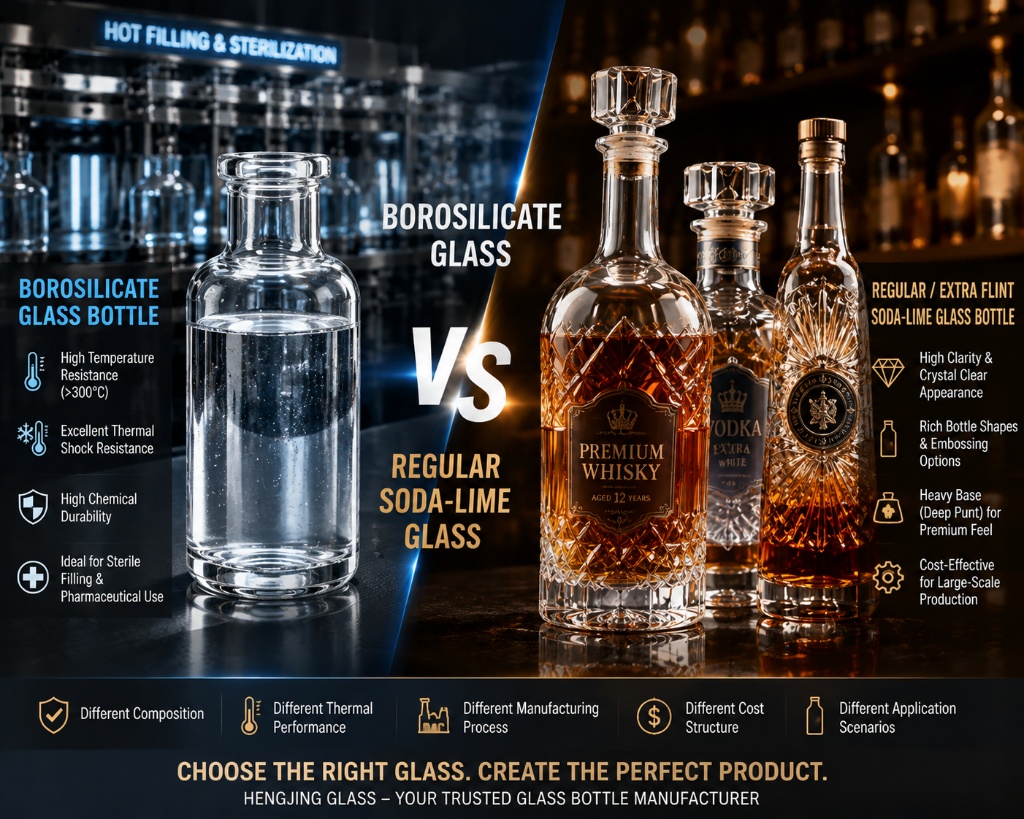
Borosilicate Glass vs Glass: What Is the Difference?
Quick Answer: Borosilicate Glass vs Glass
Borosilicate glass handles thermal shock way better. And it’s more chemically stable. But it’s also more expensive to produce.
Regular soda-lime glass? That’s the workhorse. Cheaper. Faster to make. Perfectly fine for most everyday containers. Think about it this way—if you need top-tier heat performance and purity, borosilicate is your answer. If you just need a solid, reliable bottle for room-temperature storage, regular glass does the job beautifully. No contest.
So when you’re sourcing custom glass bottles, don’t just grab the most expensive option. That’s not always the smartest move. It really comes down to your filling process. And how the bottle will actually be used. Match the material to the job.
What Is Borosilicate Glass?
Borosilicate glass contains a significant amount of boron trioxide. That’s the key ingredient.
Why does that matter? Because boron lowers the thermal expansion coefficient. Dramatically. This coefficient—COE for short—measures how much the material expands or contracts when temperatures change. Lower COE means less expansion. Less stress. Less cracking.
The boron strengthens the glass network. Keeps it stable even during rapid temperature swings. That’s why you see this material everywhere in labs. Beakers. Test tubes. Pharmaceutical vials that need to survive autoclave sterilization. It’s also the go-to for high-end heat resistant glass bottles. Specialty containers where durability under heat is non-negotiable.
What Is Regular Glass (Soda-Lime Glass)?
Regular glass is soda-lime glass. Made from silica, soda ash, and limestone. Simple recipe. Works great.
Why is it so popular? The raw materials are abundant. The melting point is relatively low. It’s perfectly suited for high-speed automated production. Look around you. Wine bottles. Whiskey decanters. Food jars. Shampoo bottles. The vast majority are soda lime glass bottles. They serve their purpose incredibly well. And they do it at a fraction of the cost.
Borosilicate Glass vs Glass: 7 Main Differences
Core Comparison Table
| Feature / Property | Borosilicate Glass | Regular Glass (Soda-Lime) |
| Main Type | Borosilicate Glass | Soda-Lime Glass |
| Thermal Expansion (COE) | Low COE (around 3.3×10⁻⁶/K) | Higher COE (around 9×10⁻⁶/K) |
| Manufacturing Method | Tubular Process / Specialty Forming | IS Machine (Blow-and-Blow, Press-and-Blow) |
| Heat & Thermal Shock Resistance | Excellent; handles rapid, extreme temperature changes | Moderate; sensitive to sudden temperature shifts |
| Chemical Durability & Purity | Outstanding chemical durability with very low ion migration | Good; perfectly fine for food, beverages, and liquor |
| Production Difficulty & Cost | High melting temps (above 1600°C), more expensive to make | Standard melting temps (around 1400°C), lower unit cost |
| Best Used For | Labware, pharma packaging, hot-fill, specialty containers | Spirit bottles, wine bottles, food jars, beverage bottles |
1. Chemical Composition Difference
Here’s the real difference. It comes down to one element. Boron.
That single addition changes the glass’s internal silicate structure. Fundamentally. Regular soda-lime glass is basically silica, sodium oxide, and calcium oxide. Borosilicate glass adds a healthy dose of borates into the mix. That makes the network tighter. Stronger. This chemical tweak is exactly why borosilicate can handle heat and chemicals so much better.
2. Heat Resistance Difference
Depending on the specific grade and design, borosilicate glass typically keeps performing well above 300°C.
That’s a big deal for food and drink production lines. If you’re running a hot-fill process or sterilizing with high-pressure steam, regular glass bottles face a real risk. Thermal stress cracking is a genuine concern. Borosilicate gives you a much safer margin. Peace of mind during those high-heat steps. Fewer broken bottles. Less downtime.
3. Thermal Shock Resistance Difference
Thermal shock resistance is all about surviving sudden temperature changes. Borosilicate handles them far better.
Why do cracks happen? Usually because the inside and outside of the glass expand at different rates. That creates stress. Under proper design and manufacturing, borosilicate glass can withstand much wider temperature swings without failing. It’s that simple.
4. Chemical Resistance Difference
Borosilicate glass has excellent chemical durability. It resists reactions. Keeps ion migration to an absolute minimum.
Regular glass? For most products, it’s fine. But think about strong acids over long periods. Or high-purity reagents. Or active essential oils. Those tiny sodium ions can leach out. Might not be a problem for a soda bottle. But for critical applications—chemical reagent bottles, high-activity essential oil containers, biological vials—borosilicate is the clear winner.
5. Mechanical Strength and Durability Difference
Borosilicate offers better scratch resistance and tensile strength. But regular glass can be reinforced through smarter design.
Here’s the thing. Physical durability isn’t just about the material itself. The bottle’s shape matters just as much. Regular glass might be slightly denser. But manufacturers can still make it remarkably tough. Heavy base designs. Deep punts. These design tweaks give regular glass bottles excellent impact resistance. And that premium, weighty feel in hand.
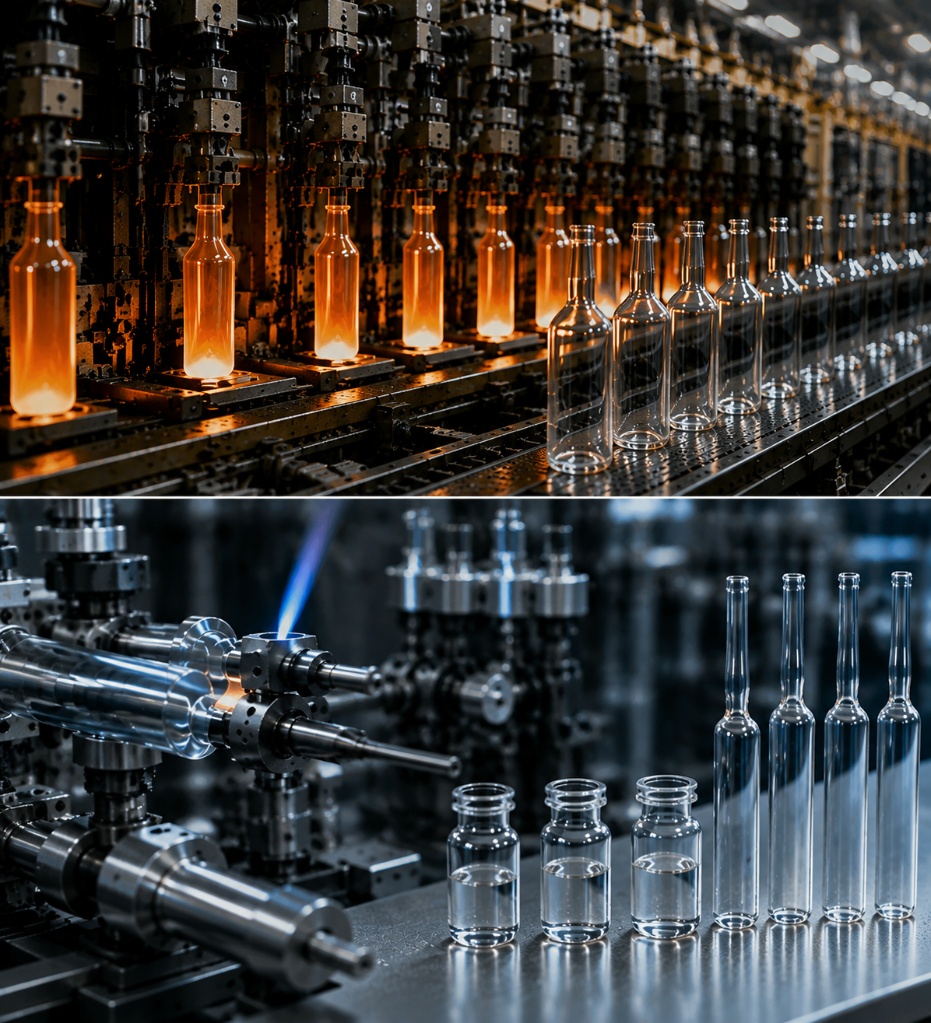
6. Manufacturing Process Difference: IS Machine vs Tubular Glass Process
The manufacturing processes are totally different. That’s a huge factor in both cost and production capacity.
Regular Glass (IS Machine Production)
Blow-and-Blow Process. Standard-neck containers. High-speed automation.
Press-and-Blow Process. Wide-mouth jars. Uniform wall thickness.
The IS Machine can pump out thousands of high-quality, consistent bottles per hour. Melting temperature? Only around 1400°C. That helps keep unit costs impressively low.
Borosilicate Glass (Tubular Glass Process & Specialty Forming)
Melting temperatures exceed 1600°C. Demands specialized refractory materials. Precise annealing control.
Often uses the Tubular Process or specialty molding.
Tubular Process is common for pharmaceutical containers. Vials. Ampoules. Precision industrial parts. Where dimensional accuracy and chemical stability are critical.
7. Cost Difference
Expect to pay more for borosilicate bottles. Plain and simple.
Why? Expensive boron raw materials. Significantly higher melting energy. Slower production speeds. For buyers, the logic is straightforward. If you’re filling at room temperature—spirits, wine, standard drinks—a high-quality regular glass or Extra Flint Glass offers excellent value. The premium for borosilicate glass bottles only makes sense when you absolutely need that heat resistance. Or sterilization. Or chemical compatibility.
Borosilicate Glass vs Regular Glass for Bottles: Which Should You Choose?
There’s no universal “better” option here. Let’s be honest about that.
The right choice depends entirely on your filling conditions. Your storage environment. Your budget. Understanding where each material shines helps you make a smart decision.
Your product stays safe. And you keep your packaging budget under control. That’s really what matters.
Now, think about custom liquor bottles. Wine bottles. Beverage packaging in general. Most manufacturers, they go with high-quality soda-lime glass. Or Extra Flint Glass. Why? It’s pretty straightforward. That combination hits a sweet spot. You get visual clarity. You get design flexibility. And production efficiency? That’s there too. That’s exactly why so many custom glass bottle producers treat soda-lime glass as the default. Especially when you’re talking big volumes. Large-scale jobs.
Choose Borosilicate Glass If:
Your product needs high-pressure steam sterilization.
Hot filling is part of your process.
End-users might heat the bottle later.
You’re packaging reactive essential oils.
High-purity chemicals or strong acids and bases are involved.
You need high-grade pharmaceutical preparations.
Your product is a high-end heat-resistant teapot or specialty container.
Consumers frequently move it between freezing and boiling environments.
Choose Regular Glass (Soda-Lime / Extra Flint Soda-Lime Glass) If:
You’re filling at room temperature. Whiskey. Vodka. Gin. Wine. Beer. Standard sauces.
You prioritize high-volume production efficiency and cost-effectiveness.
You need IS Machine speed for fast turnaround.
You want complex embossed logos.
Heavy-base designs with a premium look and feel matter to you.
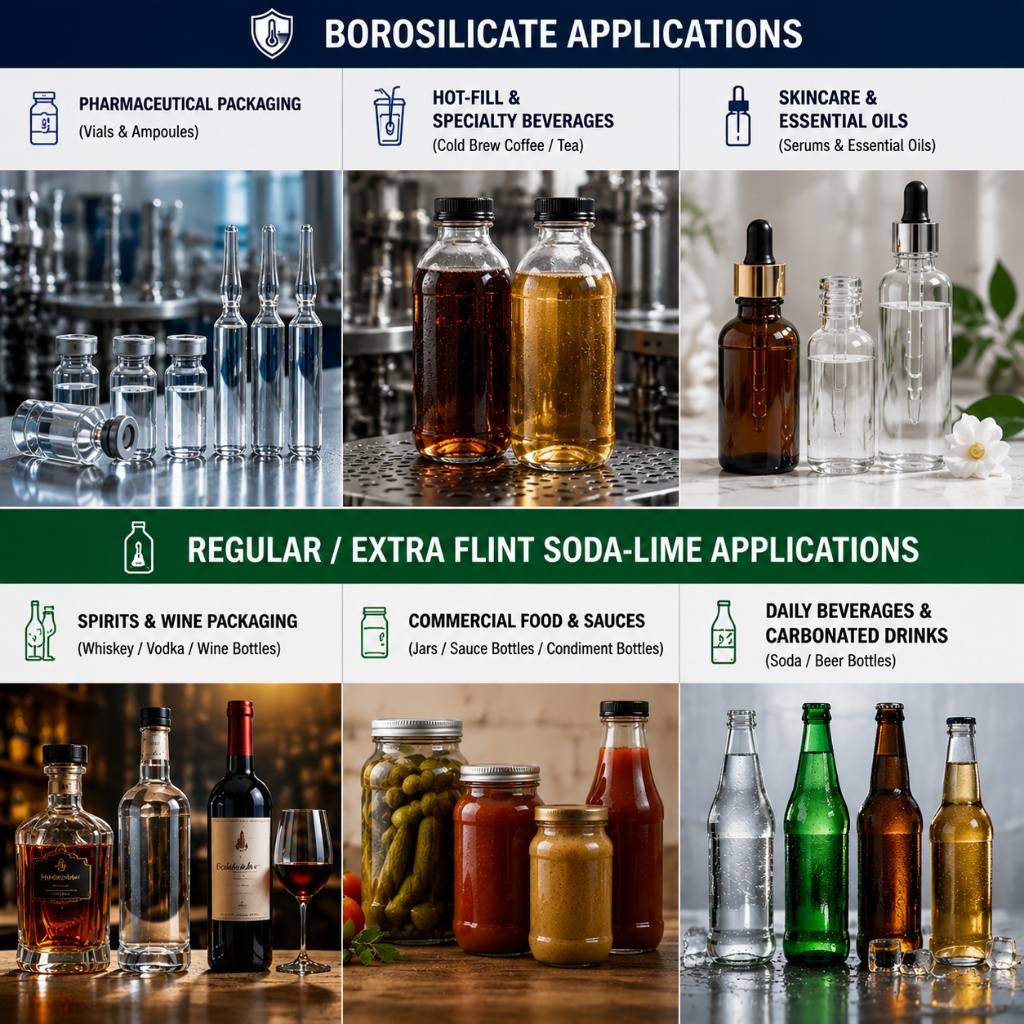
Borosilicate Glass vs Glass for Packaging Applications
Food & Beverage Packaging
For standard food and drink products, regular glass dominates. Its supply chain is mature. It’s proven.
But borosilicate glass carves out a niche. Hot-fill segments. Specialty applications. Think about everyday items. Jam jars. Soy sauce bottles. Soda bottles. All soda-lime glass. The sheer scale of production makes these products incredibly cost-competitive. Now think about premium specialty drinks. Or coffee concentrates that need boiling water poured directly into the bottle. Custom borosilicate glass bottles give consumers that extra layer of heat protection. Peace of mind.
Liquor and Wine Bottle Applications
For whiskey, vodka, wine, and other spirits, Extra Flint Soda-Lime Glass is the clear winner.
It combines premium clarity with large-scale production value. Extra Flint is frequently specified for custom liquor bottles. It balances transparency, design flexibility, and fast production capabilities. High-end spirits rely on that crystal-clear look. And the satisfying weight of a heavy base. Since filling happens at room temperature, there’s no need for borosilicate’s heat resistance. Extra Flint Glass lets distilleries maintain a luxury image. Without blowing their packaging budgets.
Pharmaceutical & Laboratory Packaging
In pharma and lab settings, borosilicate glass is the standard. It’s non-negotiable for critical applications.
Ultra-low ion migration. Excellent thermal shock resistance. Injection vials. Autoclaved vials. Chemical reagent bottles. If trace elements leach into the liquid during sterilization or long-term storage, it could compromise drug efficacy. Or skew lab results. Borosilicate’s high purity and chemical stability ensure that whatever’s inside stays stable. For years.
Cosmetics & Personal Care Packaging
In beauty and personal care, there’s a clear split.
Regular glass works beautifully for standard perfumes and lotions. But for highly active essential oils and fine chemicals, borosilicate is the safer bet. Standard perfumes and daily creams lean heavily on visual appeal. Regular high-clarity glass easily handles complex, eye-catching shapes. However, for high-concentration repair serums or active botanical extracts, the risk of interaction with packaging is real. Using borosilicate glass bottles is a smart, precautionary measure. It protects product efficacy.
How to Choose the Right Glass Material for Your Product
Step 1: Check Product Temperature Requirements
Start with the basics. What temperatures will your product see?
Production. Filling. End-use. Think about all of them. If your line includes a hot-fill step, or if your bottles need to go through an autoclave for sterilization, borosilicate’s thermal shock resistance is your safety net. If everything happens at room temperature and stays there, regular soda lime glass bottles will serve you perfectly well.
Step 2: Consider Chemical Compatibility
Next, think about what you’re putting in the bottle.
Is it acidic? Volatile? Highly purified? For water, standard spirits, and oily foods at room temperature, regular glass faces virtually no risk. Corrosion isn’t a concern. Leaching isn’t either. But if you’re dealing with strong acids, concentrated essential oils, or pharmaceutical-grade purity, it’s worth moving up to borosilicate. Its hydrolytic resistance is superior.
Step 3: Evaluate Production Volume and MOQ
Third, factor in your expected sales volume and budget. Especially the manufacturer’s minimum order quantity.
Lead times matter too. Regular glass uses giant, automated IS Machines. That means high MOQs. Often tens of thousands. But the production speed is blisteringly fast. Per-unit cost is low. Borosilicate offers more flexibility for smaller custom runs. But you’ll pay more per bottle. And you’ll wait longer for delivery.
Step 4: Balance Performance and Cost
Now comes the balancing act. Match performance needs to your supply chain budget.
Going all-in on borosilicate when you don’t need it? That inflates your packaging costs. Hurts your product’s price competitiveness. On the flip side, using regular glass in a hot-fill process just to save money? That can lead to disaster. Broken bottles. Wasted product. Smart sourcing means choosing the right material for the right job.
Step 5: Discuss Manufacturing Capability with Supplier
Finally, have a real conversation with an experienced glass factory.
Let their technical team help you. Verify the best material and forming method for your specific product. A good manufacturer will offer a full technical assessment. Wall thickness uniformity. Impact resistance ratings. AQL inspection standards. And before you commit to a massive production run, always request material test reports. Do a small pilot run. It’s the surest way to avoid surprises down the road.
Borosilicate Glass vs Glass: How to Make the Right Choice
Understanding the differences between these two materials helps buyers make smarter decisions. Product performance. Compatibility. Budget. All need to be weighed against each other.
Borosilicate glass delivers outstanding heat and chemical resistance for demanding environments. High-clarity soda-lime glass, however, remains the industry’s go-to. Large-scale, cost-effective bottle manufacturing still relies on it.
But here’s the thing. Picking the right material is just the first step. Your manufacturer’s production capabilities matter too. Their quality control systems. Their customization experience. All of that is equally critical to achieving the final packaging you envision. Hengjing Glass offers tailored custom glass bottle solutions. They provide end-to-end technical support. From material evaluation and bottle design to full-scale production.