
Consumers standing at a bar back or supermarket shelf make their first judgment about a spirit’s price point and flavor profile in just seven seconds — before they read the label, before they ask the bartender. That split-second verdict is driven almost entirely by bottle shape.
This is not an accident. Each of the four major spirits categories — whiskey, vodka, gin, and tequila — has developed its own unspoken bottle design rulebook over decades of consumer conditioning. A broad-shouldered square bottle signals authority and heritage. A tall frosted cylinder promises clinical purity. A squat dark-glass flask whispers artisanal complexity. Break those rules without a deliberate reason, and you risk confusing the very consumer you are trying to reach.
This article decodes the visual logic of each category, highlights the production realities that separate good design from great packaging, and closes with a practical engineering checklist for distillers making sourcing decisions.
Whiskey: Heritage, Weight & Premiumization
Classic Forms
Round / Boston shape. The default for bourbon and Scotch across all price tiers. Its symmetrical profile is labeling-machine-friendly, easy to grip, and well-suited to high-volume production runs. It telegraphs approachability without sacrificing credibility.
Square / rectangular shape. Johnnie Walker, Jack Daniel’s, and dozens of American bourbons have built global recognition on this silhouette. Its practical advantage is equally strong: rectangular bottles pack with near-zero void fill in standard cartons, maximizing pallet utilization and minimizing freight cost per case.
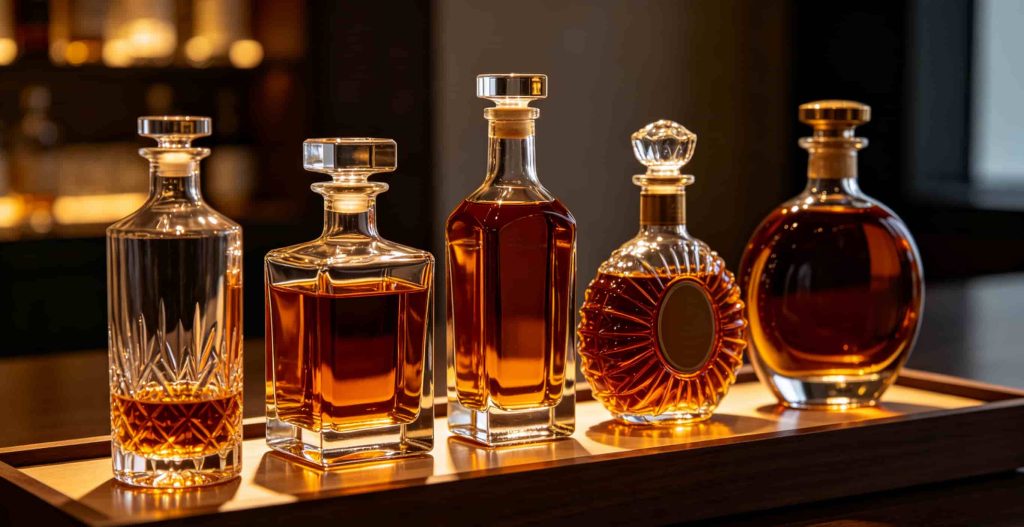
Decanter / heavy-bottom shape. The preferred form for single-cask expressions, aged statements, and ultra-premium releases. The weighted base creates a pour ritual that justifies a higher shelf price before the liquid has been tasted.
Sourcing Note
Whiskey bottles are almost universally produced in crystal-white glass to showcase the amber of the liquid. A thick, heavy base is one of the most cost-effective signals of premium positioning available to a packaging team — it is, in effect, a physical cheat code for price anchoring.
Vodka: Height, Purity & Minimalist Elegance
Classic Forms
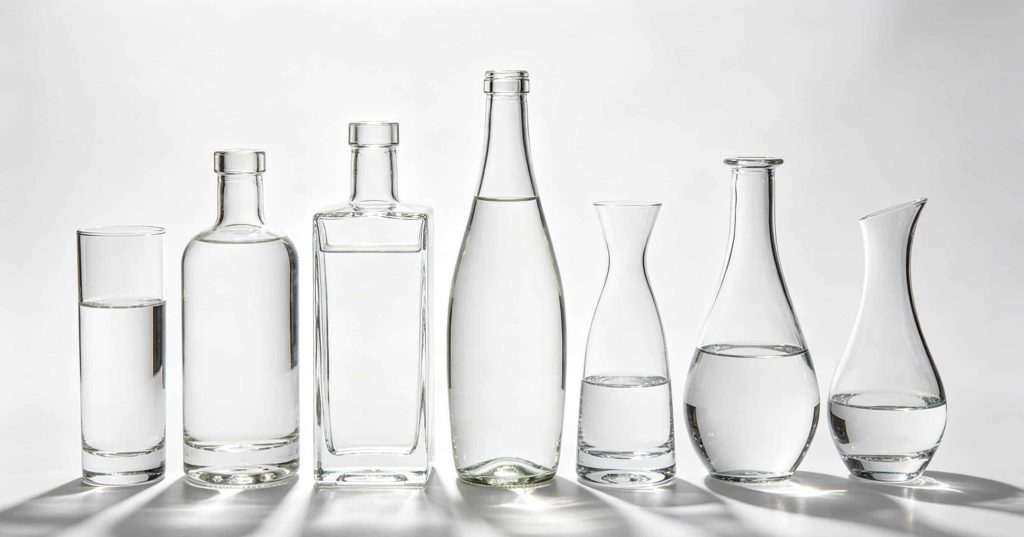
Tall cylindrical shape. Absolut, Grey Goose, and Belvedere built category dominance on this silhouette. Height commands the back bar; the uncluttered vertical line encodes the purity and multi-distillation story without a word of copy. Clear glass is near-universal — the colorless liquid is itself the proof of quality, so transparency is never optional.
Frosted / tapered shape. A bottle that narrows slightly from base to neck, often paired with a sandblasted or acid-etched surface finish, creates a chilled, crystalline aesthetic that reinforces the cold-serve ritual of premium vodka.
Production & Supply Chain Consideration
Tall bottles are inherently unstable on high-speed filling lines. Before committing to a tall-format mold, distillers must audit two specifications with their glass supplier: punt depth (the concave base that lowers the center of gravity) and verticality tolerance (the permitted deviation from a perfectly straight vertical axis). Even a 0.5mm drift can cause toppling at line speeds above 3,000 bottles per hour.
Gin: The Apothecary Spirit and the Craft Revolution
Classic Forms
Apothecary / stubby round shape. Hendrick’s defined a new visual language for premium gin when it adopted a dark Victorian medicine bottle. The form carries associations of botanical expertise, old-world pharmacy ritual, and British eccentricity — a perfect carrier for a brand built on unusual botanicals.
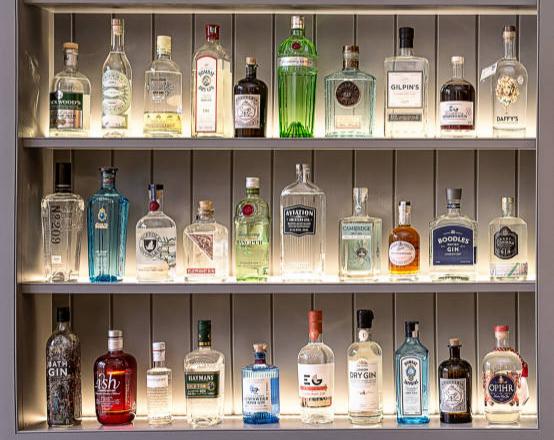
Heavily textured / embossed bottle. No spirits category experiments more aggressively with glass surface than gin. ROKU’s hexagonal form references its six Japanese botanicals. The Botanist covers its surface in hand-drawn botanical typography. This is a category where the bottle surface is part of the storytelling, not a background for a label.
Design vs. Cost Trade-off
Green, blue, and amber glass are all viable for gin and carry meaningful category associations. Custom embossing — raised lettering or botanical motifs pressed directly into the mold — delivers a perceived premium finish that far outweighs its incremental tooling cost. For craft brands, embossing a stock bottle can approximate the effect of a bespoke mold at a fraction of the price.
Tequila: Art, Agave Heritage & Organic Silhouettes
Classic Forms
Artisanal / decanter shape. Clase Azul’s hand-painted ceramic decanter is the most extreme expression of a broader category tendency: tequila bottles are designed as post-consumption art objects. Sweeping curves, metallic plaques, and ceramic textures are common at the premium tier. The bottle is explicitly intended to remain on display long after the liquid is gone.
Square / angular agave silhouette. Don Julio’s inverted trapezoid projects the rugged, land-rooted character of Jalisco’s highlands. The geometry is modern but the material language — heavy glass, oversized closures — remains anchored in craft tradition.
Engineering Challenge
Tequila brands routinely specify complex closures: oversized wooden stoppers, zinc-alloy skull caps, cork-and-wax combinations. Each of these introduces a sealing risk that standard closures do not. When specifying a non-standard finish and closure combination, distillers must test for airtight integrity under pressure differential conditions that simulate international ocean freight — where temperature fluctuation and container pressure changes can open a poorly sealed bottle mid-shipment.
Cross-Category Principles
| Dimension | Key Considerations |
| Ergonomics | Pour weight, grip diameter, balance when tipped at 45° |
| Shelf presence | Front-face width, height, color contrast against neighbors |
| Material & finish | Glass weight, mold seam quality, surface treatment |
| Closure design | Cork / screw cap / glass stopper matched to brand tier |
| Sustainability | Lightweighting, recycled glass content, carbon per case |
Engineering & Sourcing Checklist for Distillers
1. Filling line compatibility. Measure your bottle’s height, width, and neck finish against your existing rinser, labeler, and filler heads before finalizing a design. A bottle 2mm too tall will stop a line. A non-cylindrical surface will defeat a standard pressure-sensitive labeler. Involve your production manager at the brief stage — not after the mold has been cut.
2. Carton and freight economics. Irregular bottle shapes create dead space inside standard 6- or 12-bottle cartons, raising your CBM (cubic meters) per case and therefore your sea freight cost per bottle. Benchmark: if your custom shape inflates CBM by more than 15–20% versus a comparable cylindrical bottle, revisit the carton design or bottle proportions before signing off on tooling.
3. Mold budget: stock bottle + custom surface. For brands producing fewer than 10,000 cases annually, this investment rarely yields a positive return. The proven alternative: select a stock bottle from a major supplier’s catalog (Ardagh, Verallia, O-I), then differentiate through surface treatment — ceramic screen printing, acid etching, metallic foiling, or a distinctive closure. A skilled design team can make a stock bottle read as fully bespoke to the end consumer. Once annual volumes exceed 20,000–30,000 cases, the per-unit economics of a custom mold, combined with full design freedom, typically justify the upfront cost.
Conclusion
The bottles that become icons share one quality: they make the liquid’s essential character visible before the seal is broken. For distillers, bottle design is not a finishing decision — it is the first decision, and everything from brand positioning to freight margin follows from it. Build the engineering case alongside the creative brief, and both will be stronger for it.