You are launching a spirit, a wine, or maybe a ready to drink cocktail. The recipe is fine. The label looks great. The brand story is solid. But have you thought about the bottle size? Not just which one looks better on the shelf. The real question is, which liquor bottle sizes actually make sense for your business, your budget, and your brand?
This guide comes straight from a factory perspective. No fluff. We will walk you through the costs that people often miss. Which sizes fit which brands. The production traps you need to avoid. Where the industry is heading. And six questions you absolutely must ask your supplier before you place that order.
Standard Liquor Bottle Sizes Every Buyer Should Know
Let’s quickly run through the most common sizes in the industry. The table below includes the factory view, what we actually see on the production floor.
| Size | Nickname | Common Use | Factory View |
| 50 ml | Miniature / Nip | Airlines, hotels, samples | One of the hardest sizes to make. The mouth tolerance has to be extremely tight. |
| 200 ml | Half pint | Gifts, travel retail | Small volume but frequent line changes. Lead time is often longer than for large bottles. |
| 375 ml | Pint / Half bottle | Craft spirits, trial size | Fastest growing size in the last two years. Craft distilleries love it. |
| 500 ml | European standard | Gin, Cognac | Very common with European buyers. Also gaining popularity in China. |
| 700 ml | EU standard | Export to Europe | You can’t avoid this size if you want to sell in Europe. |
| 750 ml | Fifth | North America standard | The most run size on our lines. Best cost efficiency. |
| 1 L | Liter | Bars, restaurants | Good capacity but not too tall. Works well on pallets. |
| 1.75 L | Handle | Parties, bulk sales | Heavy glass, high shipping cost. But the lowest cost per bottle. |
Those numbers are just the starting point. The real know how is below.
Hidden Economics of Liquor Bottle Size
A lot of our clients hear this for the first time and say, wait, I had no idea.
Proof Gallon Tax (how your tax is calculated). The US spirits tax is based on the proof gallon. In simple terms, the higher the alcohol percentage and the larger the bottle, the more tax you pay per bottle. For example, take a 1.75 liter bottle. Between 40 percent ABV and 50 percent ABV, the tax difference can be as much as 20 percent. And different countries have completely different tax rules. My suggestion: calculate the tax for your target market before you pick a size. Sometimes going a little smaller saves you more in tax than the glass itself costs.
Pallet Optimization (how many bottles fit on a pallet). Almost nobody brings this up on their own, but it matters a lot. A one centimeter difference in bottle height can cost you one full layer on a pallet. And on a 40 foot container, that can mean hundreds of fewer cases. Freight cost is calculated by volume and weight. You do the math.
Consumer Price Anchoring (how shoppers compare prices). This might be the most overlooked pricing tool. Put a 750 ml bottle next to a 700 ml bottle. Shoppers instinctively feel the 700 ml is much cheaper. Put a 375 ml next to a 750 ml, and the big one looks like a better deal. Size itself is a price anchor.
How Liquor Bottle Size Aligns with Brand Positioning
In the spirits industry, size isn’t just about capacity. It is a pricing strategy and a piece of consumer psychology. Choosing the right size often boosts conversion more effectively than throwing money at ads. Here is how different sizes work for different market stages.
200ml and smaller: the trial cost crusher. The hardest part for a new brand is getting those first customers. Small bottles exist to lower the barrier. The user thinks, it is just a few bucks to try. If I don’t like it, no big deal. A lot of craft distilleries that went viral started with 200 ml or 375 ml bottles. They built word of mouth first. Once people wanted more, they naturally moved up to the 750 ml flagship.

375ml to 500ml: the transition size that balances curiosity and value. This segment is seeing rapid growth. It feels more substantial than a sampler but remains more affordable than a full bottle. It is the perfect fit for premium liquor packaging trends where seasonal limited editions and “entry-level” versions of high-end gins thrive.

750ml: the hard currency of the spirits world. In mainstream markets like North America, it is the standard dollar of the industry. If you don’t have a 750 ml, it is very hard to get onto mainstream retail shelves. This is your core moat. Yes, competition is fierce, but its shelf position is irreplaceable.

1L and larger: volume movers and party staples. A 1 liter or 1.75 liter sends a very clear message: cheap and plenty of it. The channels are bars, restaurants, and large family gatherings. This works best for established brands with strong loyalty, or supply chain driven brands that compete purely on value.

What It Really Takes to Manufacture Each Liquor Bottle Size
At the factory level, every bottle size has its own “temperament.” Moving from a 50ml miniature to a 1.75L magnum isn’t just about using more glass; it requires a total recalibration of the glass bottle manufacturing process.
Cold end coating (scratch protection). The spray parameters after the bottle comes out of the furnace determine how good the bottle looks. Small bottles have a tight curve, so you need to adjust the spray nozzle angle very precisely. Big bottles over 1.75 liters are heavy, so the conveyor speed has to slow down to get an even coating. If you mess up the coating, even the best design will get scratched up during shipping and become scrap.
Annealing lehr and internal stress (crack prevention). A 50 ml mini bottle and a 1.75 liter big bottle cool down at totally different speeds. If you set the annealing temperature curve wrong, the internal stress doesn’t get released. That bottle could crack during filling, or worse, right there on the store shelf. That is why we use longer annealing times for large bottles. We make sure the physical properties are stable.
Tight mouth tolerance (preventing evaporation). Small bottles like 50 ml are extremely sensitive to mouth precision. If the tolerance is off by just 0.1 millimeter, the cap won’t seal completely. Then your expensive liquid evaporates. So we inspect small bottles twice as often as standard bottles.
Internal surface treatment (a must for premium spirits). High end whiskey or cognac needs a very smooth inner bottle wall. We offer an extra internal surface treatment step to ensure the spirit stays stable. If you are a premium brand, make sure you ask about this when you request a quote.
Liquor Bottle Size Trends You Can’t Ignore
The market is changing. Here is what we are seeing.
Light-weighting trend. Johnnie Walker released a 70 cl bottle that weighs only 180 grams. That is about 29 percent lighter than traditional bottles. A lighter bottle means lower shipping costs and less carbon emissions. Today’s consumers actually care about that. You don’t have to go that extreme. But cutting glass weight while keeping strength and appearance is a real competitive advantage.
375ml and 500ml are growing. Younger consumers buy differently. They want to try more brands, but they don’t want to commit to a full 750 ml bottle every time. Half bottle sizes fit that need perfectly. For your brand, it is also a way to launch new expressions without cannibalizing your core line.
PCR (recycled glass) has limits. Post consumer recycled glass is being used more and more. But here is the problem: small bottles like 50 ml and 200 ml are harder to make with a high PCR percentage. The way the material flows is different. Factories are testing and improving. But if you want fully recycled bottles right now, larger sizes are the safer bet.
Regional preferences: which size sells where? Different markets have different favorite sizes. Don’t ignore this.
United States: 750 ml is the absolute standard. The 1.75 liter handle is strong in bars and house party channels. 50 ml miniatures are everywhere in travel and trial packs. The TTB has approved nine standard sizes; anything else needs special approval.
European Union: 700 ml is the standard for spirits. 750 ml is for wine. Smaller sizes like 200 ml and 500 ml are common in high end gift packaging.
Asia: It varies by country. In Japan and Korea, whiskey and cognac mainly come in 700 ml and 750 ml. But in craft spirits, 375 ml and 500 ml are growing fast. In high unit price markets like Singapore and Hong Kong, half bottles actually sell more because consumers want to enjoy a luxury experience with a lower entry price.
6 Questions Every Buyer Should Ask Before Ordering
First, “What size runs the most on your production line right now?”
That size will give you the shortest lead time, the most flexible MOQ, and the lowest unit price.
Second, “Do you have a stock mold (standard bottle) for this size?”
If yes, you save the 2,000 to 5,000 USD mold fee. That is huge for small test batches.
Third, “What is the tolerance on the bottle mouth?”
If they can’t give you a specific number like plus or minus 0.2 millimeters, find another supplier. Tolerance is the foundation of a good seal. Tight tolerance means reliable cap seal. Loose tolerance means leaky bottles and wasted liquid.
Fourth, “Do you keep color samples and production parameters on file?”
If they don’t archive these, your next order will have mismatched colors and inconsistent dimensions.
Fifth, “For this size, how many cases fit on one pallet? And how many on a 40 foot container?”
If they only quote you per bottle and cannot figure out full container load, they are not professional enough.
Sixth, “From sample approval to delivery, how long does it take?”
A good supplier will tell you the real timeline, usually six to eight weeks, and proactively remind you about shutdowns like Chinese New Year.
Why Hengjing Glass for Your Liquor Bottle Sizes?
Anyone can copy a size chart. But taking you from choosing a size all the way to stable delivery requires people in the factory.
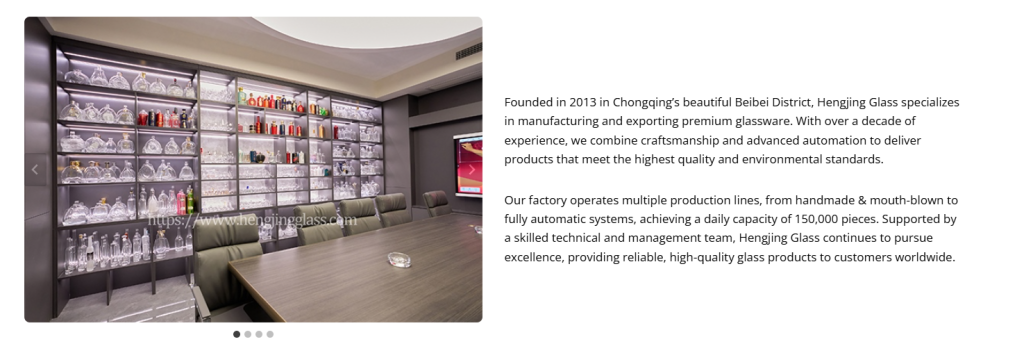
Hengjing Glass is a professional glassware manufacturer. Our production lines cover fully automatic, semi automatic, hand blown, and hand cut. So whether you need large volume standard bottles or small batch custom shapes, we can fit you into the schedule.
Let’s talk about design first. Our design team can start from a rough sketch or a hand drawing. We will turn it into a 3D model, then into a physical sample. You can track the whole progress online. And we strictly protect your design rights; no leaks. That is especially important for new brands. You put thought into your design. It should not be taken.
Then sample making and mass production. A sample isn’t just for show. It is to verify whether we can make it, whether the cap seals properly, and whether the production line will run smoothly. We will adjust the mold and process based on sample feedback until you say yes. Then we start mass production. We strictly follow factory exit inspection standards so you know exactly what you are getting. Sample quality and mass production quality are very close. We follow the principle of quality first, quality above all. That is not a slogan. It is a daily process.
Then packaging. This is where many buyers drop the ball. We simulate pallet loading for different bottle sizes in advance. The outer carton tolerance is controlled to plus or minus 2 millimeters. We use five layer corrugated board with honeycomb cushioning. That reduces friction during shipping by over 90 percent. Breakage rate is below 0.1 percent. Container space utilization is above 92 percent. In other words, almost all the freight you pay for is filled with bottles, not air.
Finally after sales and customs clearance. A dedicated consultant responds within 2 hours. The technical center connects on process issues within 1 hour. We don’t pass the buck or make excuses. We work with you to solve problems. Also, we help you apply for CO certificates, FORM A, FORM E, RCEP, and international test reports like SGS and ISO. That helps you clear customs smoothly and even enjoy tariff savings.
So if you don’t want to waste time with a supplier who only quotes prices, gets vague when you ask about production lines, skips over packaging details, and goes silent after the sale, talk to Hengjing. We will help you turn all those size decisions, cost controls, production details, and packaging optimizations into real results. Step by step.