Every brand reaches the same crossroads at some point in product development: commit to a custom glass bottle with its tooling costs and lead times, or move faster with a stock option from a supplier’s existing catalog?
The question looks like a cost calculation on the surface. But behind all that, there is a question of positioning, risk within the supply chain, and ultimately where you truly stand in terms of your company’s life cycle. In this guide, I will break down the process of comparison along three key criteria: cost, branding, and lead time.
Cost and Minimum Order Quantity: Where the Money Goes
The cost structure of custom bottles
Custom glass bottles carry two distinct cost layers: tooling fees and minimum order quantities (MOQ).
Tooling fees for a standard bottle mold typically range from $1,500 to $6,000 USD, depending on complexity. Unusual geometries, multi-part molds, or bottles with integrated closures can push costs significantly higher. This is a one-time capital expenditure — it does not scale with future orders — but it must be recovered against your production volume before the per-unit economics make sense.
MOQs for custom production generally start at 5,000 to 20,000 units per run. Combined with tooling, the financial commitment required before a single bottle reaches a consumer is substantial. For brands in early-stage growth, this level of upfront exposure carries real risk.The unit price advantage of custom bottles only becomes meaningful at scale. Below approximately 50,000 units annually, the tooling amortization often erodes whatever per-unit savings exist versus stock.
The cost structure of stock bottles
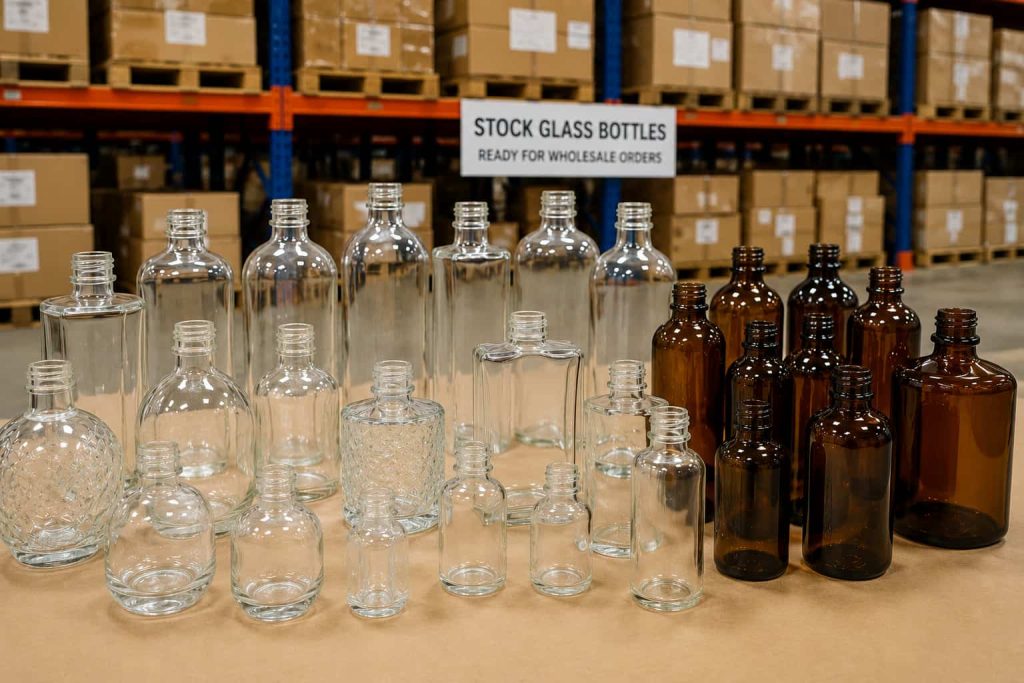
Stock bottles eliminate tooling costs entirely. MOQs range from around 500 to 2,000, although mixed orders of different SKUs can be had for even fewer. Prices per unit are higher than comparable custom bottles, although the landed cost is invariably lower in smaller and medium-sized order quantities.
The financial advantage is not just in unit economics — it is in capital efficiency. Lower inventory commitment, faster payback cycles, and reduced exposure if a product does not perform as expected.
Reference benchmarks
| Annual Volume | Recommended Direction |
| Under 10,000 units | Stock bottle |
| 10,000 – 50,000 units | Depends on price positioning and category |
| Over 50,000 units | Custom bottle economics begin to favor |
Brand Differentiation: How Much Work Should Your Packaging Do?
The case for custom
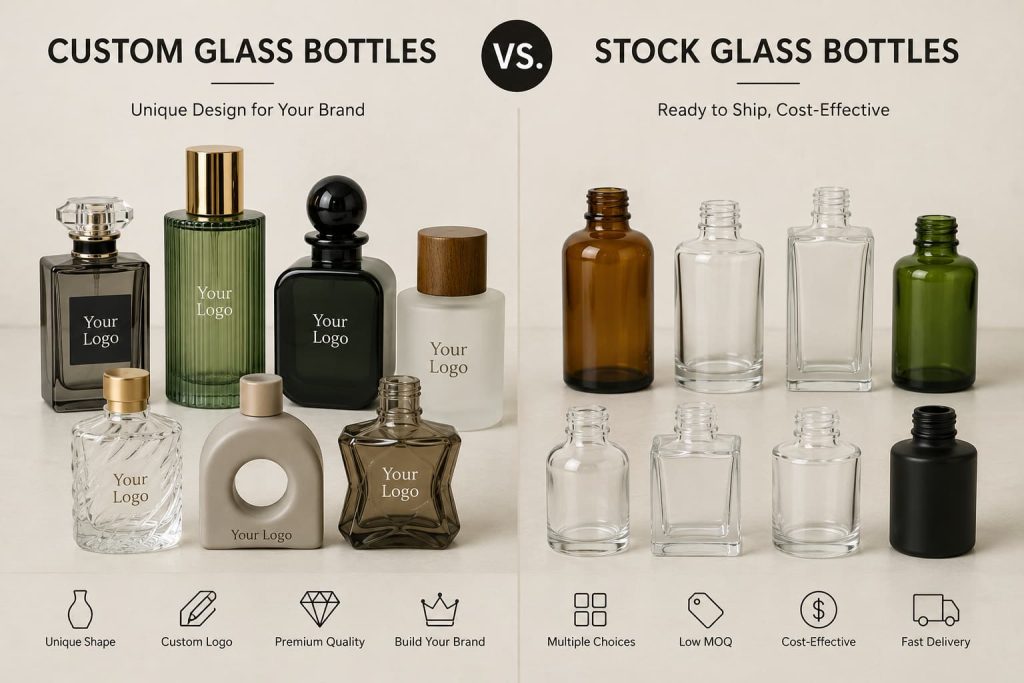
In glass packaging, form is content. A distinctive bottle silhouette communicates category positioning, price tier, and brand personality before the consumer reads a single word. This is not a peripheral benefit — in fragrance, spirits, premium skincare, and specialty beverage categories, the bottle shape is often the single most recognizable brand asset.
Custom bottles give brand owners complete design control: shoulder profile, base weight, glass color and opacity, neck finish, and closure compatibility. For brands pricing above category average, this level of control is not a luxury. Consumers assign quality cues to packaging tactility and visual weight, and those cues directly influence willingness to pay.
Where stock bottles can still deliver
Stock bottles are designed for broad utility, which means they rarely make a strong visual statement on their own. The opportunity is in secondary processing: silk-screen printing, hot stamping, frosted coating, custom labeling, and distinctive closure selection can elevate a stock bottle considerably.
For DTC brands, early-stage launches, or product lines where the repurchase logic centers on formula rather than experience, a well-designed stock bottle with premium finishing can perform strongly — particularly in e-commerce environments where the unboxing moment carries more weight than shelf presence.
The positioning threshold
The higher your retail price point relative to category peers, the more your packaging needs to justify that gap visually and tactilely. Custom bottles earn their cost at the premium end. Below that threshold, stock with strong secondary finishing is a rational and often superior choice.
Lead Time and Supply Chain Flexibility
The timeline risk of custom production
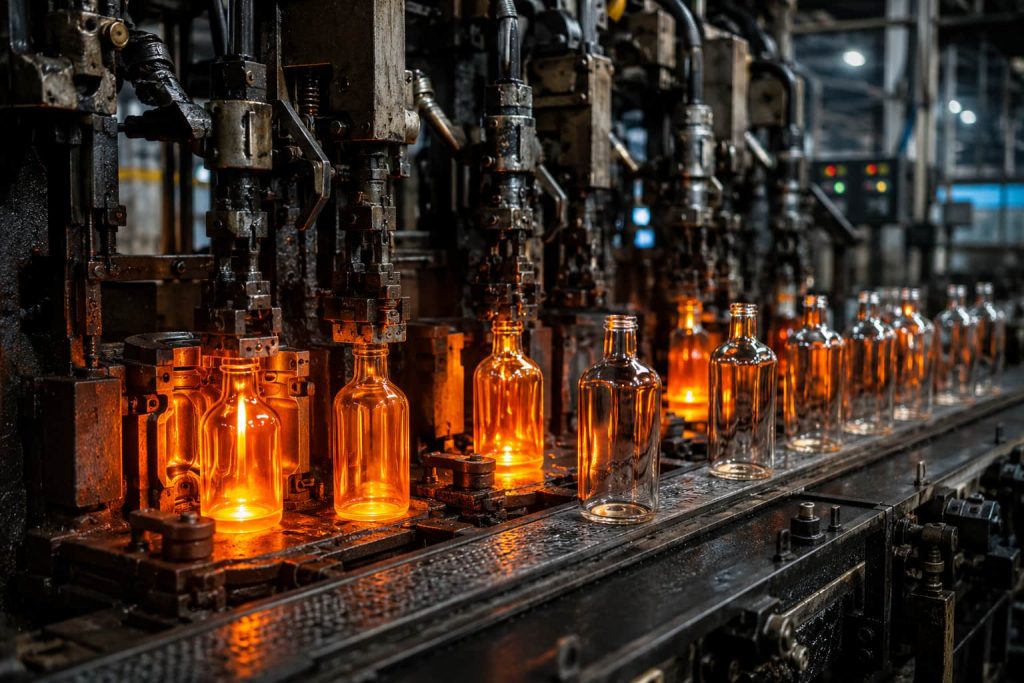
From design sign-off to first delivery, custom glass bottle production typically requires 90 to 150 days. This covers mold fabrication (45 to 60 days), sample approval, production scheduling, manufacturing, and freight.
For brands with fixed launch windows — seasonal releases, retail sell-in deadlines, major e-commerce promotions — this timeline must be built into the product development calendar at least six months in advance. Any design revision, mold modification, or quality issue resets part of that clock.
Custom bottles also create rigidity in the face of market feedback. If early consumer response suggests a different size, a reformulation requiring a different neck finish, or a pivot in positioning, the cost and delay of modifying or retiring a custom mold add friction to an already challenging iteration process.
The supply chain advantage of stock
Stock bottles operate on lead times of 7 to 30 days in most markets, with some domestic suppliers offering same-week fulfillment on standard SKUs. This speed enables meaningful supply chain advantages: faster market testing, lower cost of iteration, and the ability to scale quickly when a product gains traction.
Flexibility also extends to volume. Stock bottles allow brands to run multiple size variants — say, 30ml, 50ml, and 100ml — simultaneously without additional tooling investment, which is valuable for brands still mapping their customer’s preferred format.
The decision driver
The faster your launch cadence and the higher your SKU turnover, the more valuable stock bottle flexibility becomes. Custom bottles are best deployed on proven, stable core SKUs where volume and positioning both justify the investment.
Decision Matrix: Find Your Position
Use the following framework to assess which direction fits your current situation:
| Condition | Recommended Choice |
| Pre-launch or market validation stage | Stock bottle |
| Annual volume under 10,000 units | Stock bottle |
| Strong visual IP or bottle-as-brand-asset ambition | Custom bottle |
| Launch required within 60 days | Stock bottle |
| Core SKU validated, entering scale phase | Custom bottle |
| Limited upfront capital | Stock bottle |
| Primarily shelf-distributed with high competitive density | Custom bottle |
A proven sequencing strategy: Launch with stock bottles to validate product-market fit → once a SKU demonstrates volume and retention, initiate custom mold development → use the custom bottle to support brand elevation and channel expansion. This path minimizes early-stage risk without permanently closing the door on premium packaging.
Practical Guidance by Path
If you are moving toward custom
Plan your timeline rigorously. Build a reverse launch calendar from your target on-shelf date. Custom bottle development requires a minimum 5-month buffer; more is safer.
Lock formula and fill specs before mold design. Bottle geometry must accommodate your fill line equipment, closure system, and any secondary processing. Design changes after mold fabrication are expensive and time-consuming.
Explore semi-custom options. Many manufacturers offer modifications to existing mold bases — adjusting proportions, adding embossing, or changing the neck finish — at 40 to 60 percent of full custom mold cost, with shorter lead times. This is an underused middle path worth evaluating.
Protect your tooling intellectually. File a design patent on any distinctive bottle form before production begins. Ensure your supplier agreement specifies that the mold is your property and cannot be used for third-party production.
If you are staying with stock
Invest in secondary processing. Silk-screen printing, hot stamping, and specialty coatings are where stock bottles earn differentiation. Do not treat finishing as a cost to minimize — treat it as the primary branding lever.
Qualify your supplier’s inventory depth. Understand their standard stock levels and replenishment lead time before you have a product performing above forecast. Supply disruption on an established SKU is a costly problem.
Set a volume trigger to revisit custom. When annual volume on a single SKU approaches 30,000 units, rerun the custom bottle economics. The crossover point is closer than most brands expect.
Standardize around a single bottle form where possible. Running multiple SKUs on a single stock bottle reduces procurement complexity and improves your leverage with suppliers on pricing and priority.
Conclusion
Custom and stock glass bottles are not in competition with each other — they serve different stages of brand and business development. Stock bottles offer the capital efficiency and supply chain agility that early-stage and high-velocity brands need. Custom bottles deliver the visual differentiation and shelf authority that scale-stage and premium brands require.
The most effective approach is to treat custom packaging not as a founding commitment, but as a milestone investment — one that is earned by product-market validation and made possible by the volume that follows. Start where your business is. Build toward where it is going.
If you are evaluating specific bottle forms or want to assess semi-custom options for your next production run, contact us to request samples and a project timeline.